What is a narrative?
Key takeaway: A narrative is a told account of connected events.
A narrative is an account of connected events told by a narrator in a chosen order. It may be fiction or non-fiction, written or spoken. A narrative has characters, a setting, a plot and a point of view. The way it is told shapes what the reader feels.
The key word is told. A narrative is not only a list of events. It is those events shaped by a voice, an order and a purpose.
Merriam-Webster lists the dictionary meaning of the word.
Narratives appear in many forms:
- Novels and short stories. Fiction told in prose.
- Memoir and biography. Real lives told as stories.
- News features. Real events told with characters and scenes.
- Films and plays. Narrative told through image and speech.
- Oral stories. Tales passed by voice.
- Brand stories. A company tells how it began.
Writers also use the word for the narrative mode of writing. Teachers often list four classic modes. Narrative tells a story. Description paints a scene. Exposition explains. Argument persuades. Most real texts blend modes.
Narrative versus story is a common question. A story is the full set of events in the order they happen. A narrative is how those events are told. A narrative may start at the end, skip years or follow two timelines. The story stays the same, but the narrative changes.
If you want to see how the lead fits into a narrative, a guide to character types helps.
Narrative vs story vs plot
Key takeaway: The story is what happens. The plot is why it happens. The narrative is how it is told.
These three terms overlap. A simple table shows the split.
| Term | What it covers | Question it answers |
|---|---|---|
| Story | Events in time order | What happened? |
| Plot | Events linked by cause | Why did it happen? |
| Narrative | Events as told | How is it told? |
A short example makes this clear. Take three facts:
- The queen died.
- The king died.
- The king died of grief.
The first two are a story, just events. The third is a plot, because it links the events by cause. A narrative decides how to tell it. It might open with the king's grief and then reveal the queen's death. Or it might follow a servant who watches both.
Order, voice and focus belong to the narrative. Two writers can tell the same story as two different narratives. One may be funny and quick. The other may be sad and slow.
This is why narrative matters to writers. The events matter, but the telling matters just as much. A weak telling can ruin a strong story.
Planning helps with this choice. An outline lets you see the events and test different orders.
Elements of a narrative
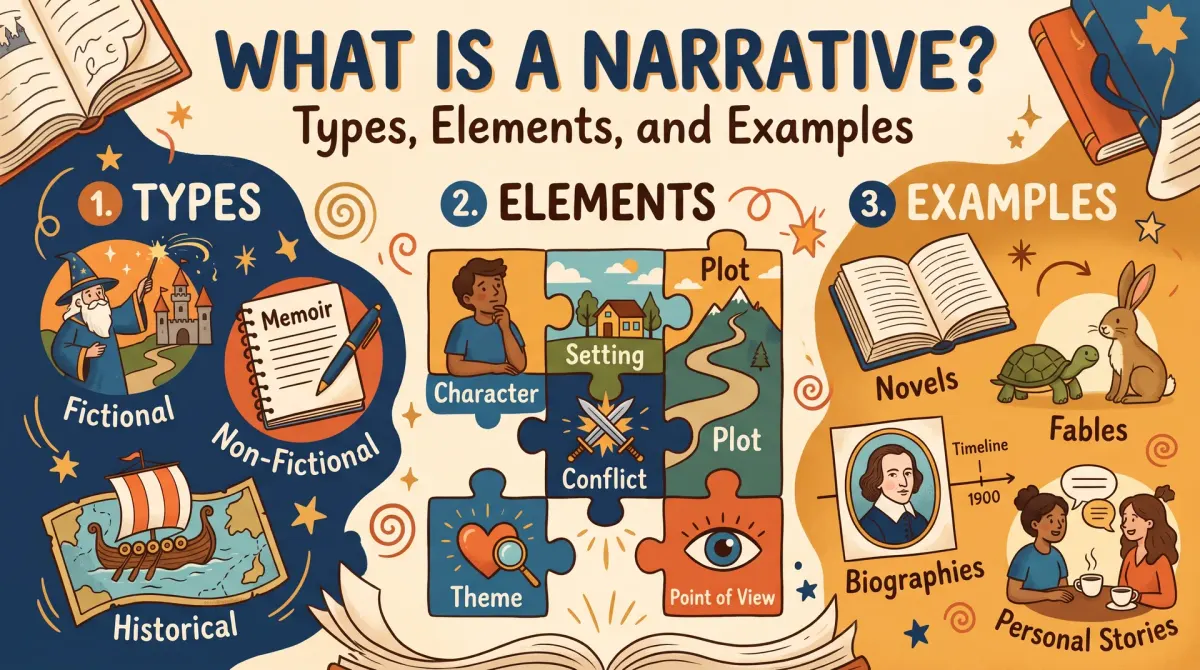
Key takeaway: Every narrative has six core elements: character, setting, plot, conflict, theme and point of view.
Most teachers and editors name the same core parts.
- Characters. The people, animals or beings in the story. The lead is the protagonist.
- Setting. The time and place, plus the mood.
- Plot. The chain of events, linked by cause.
- Conflict. The struggle that drives the plot.
- Theme. The central idea or message.
- Point of view. The angle from which the story is told.
Plot often follows a classic shape: exposition, rising action, climax, falling action and resolution. Not every narrative follows it. Some modern stories break the pattern.
Voice is a seventh element worth noting. Voice is the style and attitude of the narrator. Two narrators can share the same facts and sound very different.
Each element supports the others. Setting shapes mood. Conflict shapes character. Theme gives the plot meaning.
A good test is to remove one element and see what breaks. A story without conflict is a list. A story without setting floats. A story without a theme feels empty.
For non-fiction, the same elements apply. A memoir has characters, a setting and a plot drawn from real life. A news feature has a setting, a conflict and a point of view.
Types of narrative
Key takeaway: Narratives differ by order, purpose and form. Pick the type that fits your story.
Writers sort narratives in a few ways. Here are the most common.
By order
- Linear narrative. Events are told in time order, from start to finish.
- Non-linear narrative. Events are told out of order, with flashbacks or jumps.
- Circular narrative. The story ends where it began.
- Frame narrative. A story is told inside another story.
By purpose
- Fictional narrative. Invented events.
- Personal narrative. The writer's own experience.
- Historical narrative. Real past events told as a story.
- Descriptive narrative. A narrative that leans on rich detail.
By viewpoint
- First person. "I" tells the story.
- Third person. "He" or "she" tells the story.
- Multiple viewpoint. More than one narrator.
A narrative can mix types. A novel may be non-linear, in the third person and a frame story at once.
The type shapes the reader's experience. Linear narratives feel clear and steady. Non-linear narratives build mystery. Frame narratives add layers.
Pick by asking what you want the reader to feel. If you want clarity, go linear. If you want curiosity, jump around. If you want depth, add a frame.
Narrative examples
Key takeaway: Strong narratives use order and voice on purpose.
Here are well-known examples. Details of structure vary by edition and reading.
- A Christmas Carol. A linear story with ghost visits that move through past, present and future.
- Wuthering Heights. A frame narrative, with one narrator telling a story he heard from another.
- The Catcher in the Rye. A first-person narrative told in a strong, personal voice.
- Frankenstein. A frame narrative with letters that hold a story inside a story.
Outside fiction, a good example is a personal essay. A writer describes one day and what it taught them. The events are small, but the telling gives meaning.
Films offer clear models. Some open with the ending and then show how it happened. Others cut between two time periods. The order changes what the audience wonders about.
Brand stories are narratives too. A company may tell how a founder started in a garage. The facts are chosen to support a message.
How order changes the effect
Key takeaway: The same events can feel calm, tense or sad depending on the order of telling.
Most pages stop at a list of types. A scene-order check shows how order works in practice.
Here is a worked example. A novel has 12 scenes. In time order, they run 1 to 12. The writer tests two plans.
Plan A: linear. Scenes run 1, 2, 3, and so on to 12. No flashbacks.
- Scenes out of order: 0
- Share out of order: 0 ÷ 12 = 0 percent
Plan B: non-linear. The book opens with scene 12, then jumps back to scene 1. Scenes 4, 5 and 8 appear as flashbacks.
- Scenes out of order: 1 (opening) + 3 (flashbacks) = 4
- Share out of order: 4 ÷ 12 = 0.33, or about 33 percent
Plan A feels steady. The reader follows cause and effect. Plan B adds mystery. The reader sees the end first and wonders how it happens.
Neither plan is better. They suit different goals. A thriller may favor Plan B. A coming-of-age story may favor Plan A.
A common guide is to keep out-of-order scenes to a clear minority so readers do not get lost. About 25 to 35 percent is a planning idea, not a rule. Label time shifts with a date, a chapter heading or a clear cue in the first line.
How to write a narrative step by step
Key takeaway: Plan the events, choose the telling, then write scene by scene.
Use these steps for a story or a personal narrative.
- Choose the main event or change.
- List the key events in time order.
- Pick a point of view and a voice.
- Choose the order of telling.
- Draft each scene with a goal and conflict.
- Add setting and sensory detail.
- Revise for clarity and pace.
Step three matters more than most writers expect. First person gives closeness. Third person gives range. Test a paragraph both ways.
Step four is the narrative choice. Ask where to start. Many stories begin close to the first change, not at the beginning of the lead's life.
For a personal narrative, such as a school essay, keep it tight. Pick one event. A 500-word narrative might give 75 words to the opening and 300 to the event. The last 125 words can hold the reflection. Check the total: 75 + 300 + 125 = 500 words.
The Purdue Online Writing Lab has free guides for narrative essays.
People Also Ask
What is the difference between a narrative and a story?
A story is the set of events in time order. A narrative is how those events are told, including the order, voice and focus. Two narratives can tell the same story in different ways. One may start at the end, while the other follows the events in order.
What are the four types of narrative?
Common lists name linear, non-linear, circular and frame narratives. Others use four writing modes: narrative, descriptive, expository and argumentative. The first list sorts by structure. The second sorts by purpose. Check which list your teacher or editor uses before you begin.
What are the elements of a narrative?
The six core elements are characters, setting, plot, conflict, theme and point of view. Voice, the style and attitude of the narrator, is a useful seventh element. Each supports the others. A narrative with a weak element often feels thin or unclear.
Common mistakes
- Using narrative and plot as if they mean the same thing.
- Jumping in time without clear cues.
- Choosing a point of view without testing it.
- Starting too early in the lead's life.
- Telling the events without a clear change or point.
Your next step: test two orders
List the scenes of your story in time order. Write a second order that starts later or jumps. Compare the two. Count how many scenes are out of order and check the share. Pick the order that matches the feeling you want.
For a full plan, the novel guide shows how to turn scenes into chapters.