What is a subplot?
Key takeaway: A subplot is a smaller story line that supports and shapes the main plot.
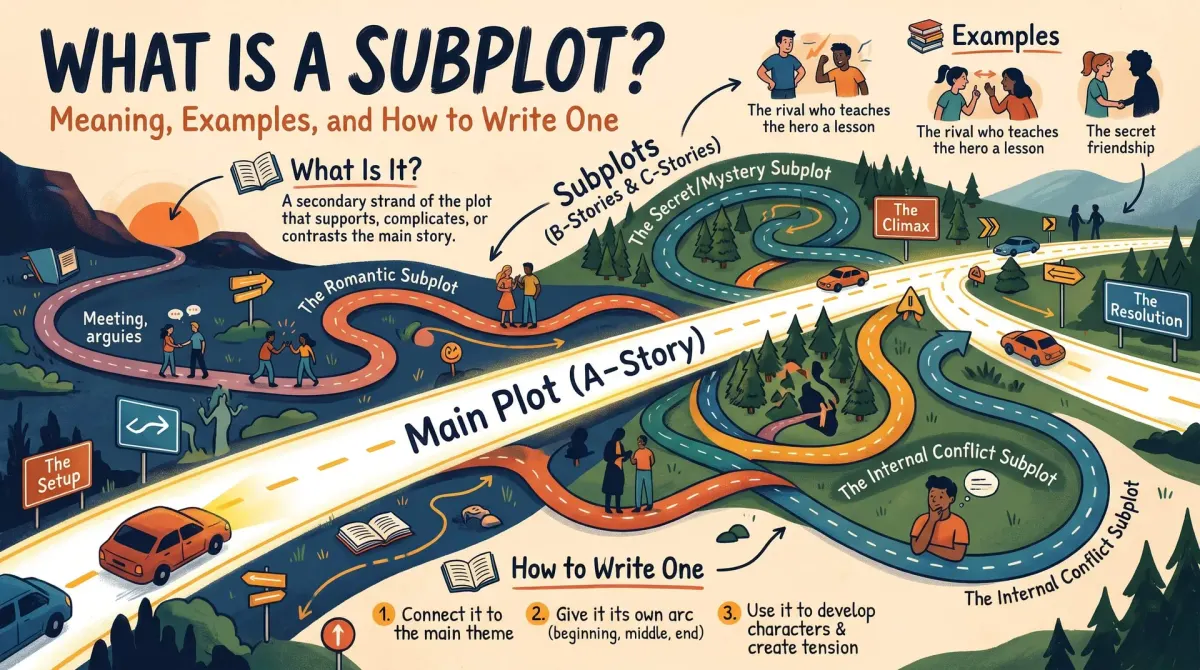
A subplot is a secondary story line that runs alongside the main plot of a book, play or film. It has its own goal, conflict and outcome, often involving a supporting character. A subplot adds depth, tests the lead and connects to the main story by the end.
The main plot is the central chain of events. It follows the protagonist's biggest goal. The subplot is a lesser chain. It may follow the same lead or a different character.
A subplot does not stand alone. If you could remove it and the book would not change, it does not earn its place. A good subplot touches the main plot at key points.
It helps to know the other terms:
- Main plot. The central story that drives the book.
- Subplot. A secondary story line that supports the main plot.
- Plot twist. A sudden change in direction.
- Story arc. The overall path of a story or a character.
Merriam-Webster gives the dictionary meaning of a subplot.
A subplot can also be called a B-story in screenwriting. The main plot is the A-story. Writers of novels use the term less often, but the idea is the same.
If you are unsure who leads your story, a guide to the lead role may help. The lead sets what counts as main and what counts as secondary.
Why stories need subplots
Key takeaway: Subplots add depth, vary the pace and show more sides of the theme.
A subplot does four jobs.
- It adds depth. The reader sees more of the world and the cast.
- It varies the pace. A quiet subplot gives rest between tense scenes.
- It tests the theme. A second story can echo or challenge the main idea.
- It builds the lead. A subplot shows sides of the lead that the main plot hides.
Think of a thriller about a detective on a case. The main plot is the hunt. A subplot about the detective's strained marriage shows the cost of the job. The two lines meet when a late night at work breaks the marriage or saves it.
Subplots also support length. A short story of 3,000 words has room for one line. A novel of 90,000 words has room for several. A subplot fills space without padding because it has its own tension.
Still, a subplot is a tool, not a rule. A tight thriller may need none. A short novel may do well with one.
If you plan on paper first, an outline shows how many lines you have. It also shows where they cross.
Subplot examples from well-known stories
Key takeaway: In strong stories, the subplot echoes or tests the main plot.
Here are examples from works many readers know.
- Pride and Prejudice. The main plot follows Elizabeth Bennet and Mr. Darcy. A subplot follows her sister Jane and Mr. Bingley. Another subplot follows her sister Lydia and Mr. Wickham. Each pair shows a different view of love and money.
- King Lear. The main plot follows the king and his three daughters. A subplot follows the Earl of Gloucester and his two sons. Both stories show a father who misjudges his children.
- The Hunger Games. The main plot is Katniss's fight to survive the arena. Her bond with Peeta is a subplot that tests her trust and her sense of what is real.
Notice the pattern. In each case the subplot repeats the theme in a new setting. In King Lear, two fathers make the same error. That echo makes the theme stronger.
Subplots can also contrast. In a story about courage, a subplot may show a character who runs away. The contrast sharpens the lead's choice.
For more on classic plays such as King Lear, Britannica offers free summaries.
Subplots in screenplays and series work the same way. A TV drama may have an A-story, a B-story and a C-story in each episode. They often resolve in a single hour.
Types of subplot
Key takeaway: Common types include romance, family, mentor, rival and mystery subplots.
Writers group subplots by what they do.
- Romance subplot. A love story that runs beside the main plot.
- Family subplot. A conflict with a parent, child or sibling.
- Friendship subplot. A bond that is tested or broken.
- Rival subplot. A contest with someone who wants the same thing.
- Mystery subplot. A small secret that the lead or a friend uncovers.
- Mentor subplot. A teacher's own past or struggle.
- Inner subplot. A private fight with fear, doubt or guilt.
Any of these can support any genre. A fantasy quest can include a romance. A crime story can include a family drama.
The type should match the theme. A story about trust may use a friendship subplot. A story about ambition may use a rival subplot.
A parallel subplot repeats the main plot in a different setting. A contrast subplot shows the opposite outcome. Both are tools to sharpen your theme.
Types of conflict can help you plan. A subplot can use a different kind of conflict than the main plot. If the main plot is person against person, the subplot may be person against self.
How much space should a subplot take?
Key takeaway: A subplot should take a clear, small share of the book. Plan it with numbers.
Most pages do not say how much space to give a subplot. A word budget solves that. There is no fixed rule. The shares below are a planning example, not a standard.
Here is a worked example for a 90,000-word novel.
- Main plot: 70 percent
- Subplot A: 15 percent
- Subplot B: 15 percent
Now do the math.
- Main plot: 90,000 × 0.70 = 63,000 words
- Subplot A: 90,000 × 0.15 = 13,500 words
- Subplot B: 90,000 × 0.15 = 13,500 words
Check the total: 63,000 + 13,500 + 13,500 = 90,000 words.
Now turn words into scenes. Say an average scene runs 1,500 words. Each subplot gets 13,500 ÷ 1,500 = 9 scenes. The main plot gets 63,000 ÷ 1,500 = 42 scenes.
Subplot scenes do not need to be separate. Many scenes serve both the main plot and a subplot. A dinner scene can advance the case and the marriage at once. In that case, the true share of "subplot" words will be lower than the count.
If you plan a 60,000-word novel, scale it down. A main plot at 70 percent is 42,000 words. One subplot at 20 percent is 12,000 words. The leftover 10 percent, 6,000 words, goes to setup and wrap-up.
Check your genre's usual length as well. A thriller is often shorter than an epic fantasy. The length guide lists common ranges.
How to weave a subplot into your story
Key takeaway: Give the subplot its own goal, link it to the main plot and resolve it before the climax.
Use these steps to add a subplot to a draft.
- Pick a supporting character with a clear goal.
- State the subplot's theme in one sentence.
- Place three to five scenes along the main timeline.
- Link at least two scenes to main plot events.
- Raise the stakes in the middle of the book.
- Resolve the subplot before or during the climax.
- Cut any scene that does not serve either plot.
Step four is the key. A subplot that never touches the main plot feels like a separate story. Make the two cross. A character from the subplot may carry vital news. A choice in the subplot may force a choice in the main plot.
Step six is about timing. Many writers wrap the subplot shortly before the main climax. That way the final scenes belong to the main plot. Some stories reverse this. The subplot's outcome sets up the final choice.
A tie-in test can help. For each subplot, answer three questions:
- Does it echo or challenge the theme?
- Does it change a choice the lead makes?
- Would the ending be different without it?
If you answer yes to at least two, keep it. If you answer no to all three, cut it or fold it into another line.
Common subplot problems
Key takeaway: Most problems come from subplots that are too long, too loose or never resolved.
Watch for these issues in your draft.
- Too many lines. More than two or three subplots can crowd a mid-size novel.
- No link. The subplot never meets the main plot.
- No ending. The reader is left asking what happened to the character.
- Stolen focus. The subplot is more interesting than the main plot.
- Late arrival. The subplot starts too far into the book.
If the subplot is more exciting than the main plot, ask whether you chose the wrong lead. Sometimes a draft reveals its true center late.
For short fiction, the advice is different. A short story has little room. One line is usually enough. If you find a second line, ask whether it belongs in another story.
People Also Ask
What is the difference between a plot and a subplot?
The plot is the main chain of events that drives the story. A subplot is a smaller, secondary chain that runs beside it. The plot follows the lead's biggest goal. A subplot follows another goal and supports or tests the main story. It usually has less page time.
How many subplots should a novel have?
There is no fixed number. Many novels have one to three subplots. A short novel may have only one. An epic with a large cast may have more. The right number is the amount your word count and theme can support without losing focus on the main plot.
Can a subplot be more important than the main plot?
It can happen in a draft. If the subplot grabs more reader interest than the main plot, review your story. You may need to swap the lines, or give the main plot higher stakes. A subplot should support the main story, not replace it.
Common mistakes
- Adding a subplot to fill space, with no link to the theme.
- Leaving a subplot unresolved at the end.
- Giving a subplot more scenes than the main plot.
- Starting the subplot too late to build tension.
- Using too many subplots in a short book.
Your next step: map your lines
List your main plot and every subplot in a simple table. Write the goal, the key scenes and the ending of each. Then run the tie-in test.
If a subplot fails the test, cut it or rewrite it. If you do not yet have an outline, start with a template and add the lines as you go.