What is an antagonist?
Key takeaway: The antagonist is the force that stands against the protagonist's goal.
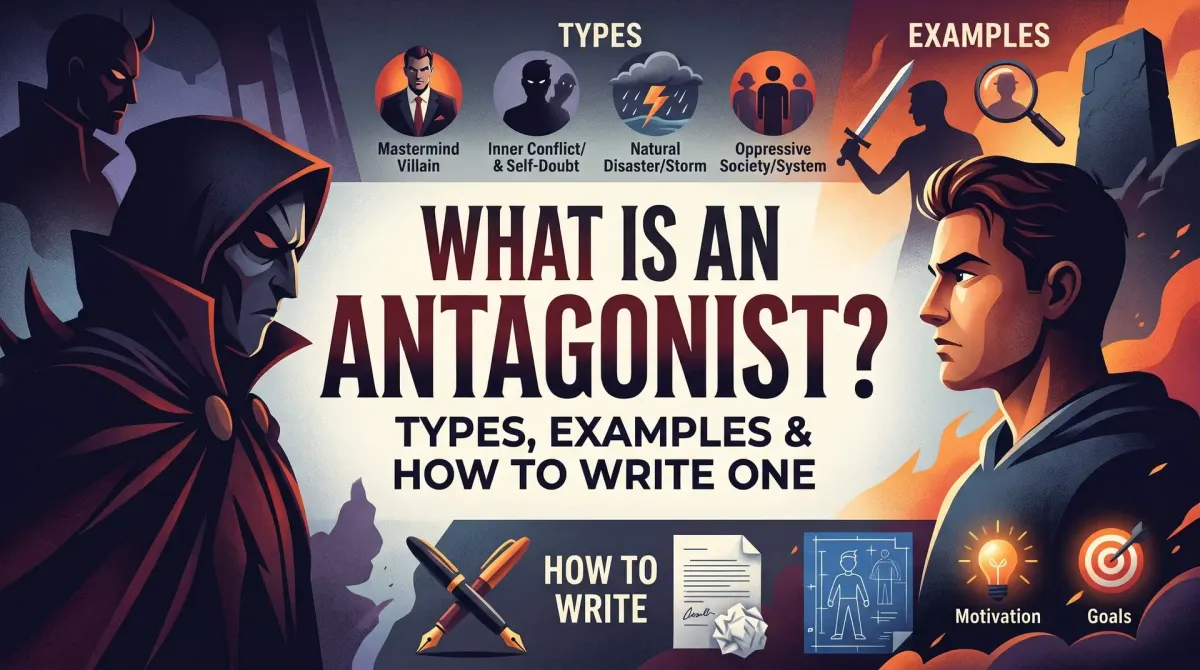
An antagonist is the character, group or force that opposes the protagonist in a story. The antagonist blocks the lead's goal and creates conflict. It may be a villain, a rival, a society, nature or an inner flaw. The role is defined by opposition, not by evil.
The word comes from Greek and means "opponent." In a story, the antagonist is the other side of the conflict.
Merriam-Webster lists the dictionary meaning.
The antagonist is a role, not a personality. A kind person can be an antagonist if their goal clashes with the lead's. A parent who forbids a dream is one case.
The antagonist works with the protagonist. The two define each other. The lead's goal gives the antagonist a reason to act. The antagonist's moves test the lead.
Here is the pair in a few lines:
- Protagonist. Wants something and pursues it.
- Antagonist. Wants something that blocks it or opposes the method.
- Result. Conflict, which drives the plot.
If you are not sure who leads your story, a guide on character types can help.
Types of antagonist
Key takeaway: Antagonists come in several forms. Pick the type that serves your theme.
Writers sort antagonists into a few groups.
| Type | What it is | Example feel |
|---|---|---|
| Villain | A person who does harm | Voldemort |
| Rival | A person with the same goal | A rival athlete |
| Force | Nature, society or fate | A storm or a regime |
More types worth knowing:
- The inner antagonist. The lead's own fear, guilt or flaw. This is internal conflict.
- The group. A gang, a company or a government.
- The mentor gone wrong. A trusted guide who turns.
- The well-meaning opponent. Someone who wants the best but disagrees on how.
- The unseen antagonist. A threat the reader feels but rarely sees.
Choose the type that matches your theme. A story about ambition may use a rival. A story about freedom may use a regime. A story about fear may use an inner antagonist.
An antagonist can change over a story. A rival can become an ally. An ally can become a foe. These shifts keep the plot fresh.
A related idea is the foil. A foil contrasts with the lead but may not oppose. An antagonist opposes. The two can overlap.
Antagonist vs villain
Key takeaway: Every villain is an antagonist. Not every antagonist is a villain.
People often use the two words as if they mean the same. They do not.
A villain is a character who does evil or harmful acts. A villain is usually an antagonist, because they oppose the hero.
An antagonist is any opposing force. It may not be evil. A detective's partner who wants to follow the rules can be an antagonist to a detective who bends them. Neither is a villain.
Here is a quick check. Ask two questions:
- Does this character block the lead's goal? If yes, antagonist.
- Does this character do wrong on purpose? If yes, villain.
A character can be an antagonist only. A character can also be a villain only, if they harm others but do not block the lead. Many are both.
In The Hunger Games, President Snow is both a villain and an antagonist. The Capitol as a system is an antagonist too. In Pride and Prejudice, Elizabeth's pride and her prejudice work against her. They are an inner antagonist, and no villain appears.
The choice of type matters for tone. A story with a pure villain feels like an adventure. A story with a well-meaning opponent feels like a drama.
Famous antagonist examples
Key takeaway: Memorable antagonists have clear motives and real power.
Here are examples that many readers know.
- Lord Voldemort in Harry Potter. A villain who seeks power and fears death.
- Captain Ahab in Moby-Dick. Often read as both hero and antagonist. His quest for revenge drives his crew to ruin.
- Nurse Ratched in One Flew Over the Cuckoo's Nest. A figure of control who represents the system.
- The sea in The Old Man and the Sea. A force of nature that tests the old fisherman.
- Macbeth's ambition in Macbeth. An inner force that drives him to ruin.
Notice the range. Some are people. Some are forces. Some are inner struggles. Each one tests the lead in a way that fits the story's theme.
Strong antagonists also share a feature: they believe they are right. Few people think of themselves as the villain. The best antagonists have a motive that makes sense from inside.
That makes them scarier and more human. A reader may even sympathize with a goal while fearing the methods.
How strong should an antagonist be?
Key takeaway: The antagonist should match or exceed the lead in power, so each win costs something.
Most pages say "make the antagonist strong" but give no way to plan. A pressure ladder gives you a method.
A pressure ladder is a list of the antagonist's moves, each stronger than the last. Rate each move from 1 (small) to 5 (huge).
Here is a worked example for a novel of 90,000 words. You plan five moves.
- Move 1 (chapter 3): a threat. Pressure 1.
- Move 2 (chapter 9): a theft. Pressure 2.
- Move 3 (chapter 15): an attack on an ally. Pressure 3.
- Move 4 (chapter 22): a betrayal. Pressure 4.
- Move 5 (chapter 28): a direct strike at the lead. Pressure 5.
Add the pressure: 1 + 2 + 3 + 4 + 5 = 15 points.
Average pressure: 15 ÷ 5 = 3.
The ladder rises each time, which builds tension. If two moves have the same pressure, the story stalls. If a big move comes too early, the rest feels smaller.
Now check the spacing. With 30 chapters in total, five moves fall about every 6 chapters, because 30 ÷ 5 = 6. That matches a steady rise.
Next, plan the lead's response to each move. A move should force a hard choice. The lead should lose something at moves 3 and 4. A story where the lead always wins early has no tension.
The antagonist also needs scenes. A reader should feel the threat even when the antagonist is offstage. A common guide is to show the antagonist or their effects in about one scene in four. This is a planning idea, not a rule.
For planning the plot, an outline template helps you place each move.
How to write an antagonist step by step
Key takeaway: Build the antagonist from the lead's weakness and give them a motive.
Use these steps to build a strong opponent.
- State the lead's goal and weakness.
- Choose a type of antagonist.
- Give the antagonist a clear motive.
- Give them a real skill or power.
- Plan five moves on a pressure ladder.
- Add one trait that makes them human.
- Check the antagonist against the theme.
Step one is the key. A great antagonist attacks the lead's weakness. If the lead fears loss, the antagonist takes things away. If the lead hides a secret, the antagonist exposes it.
Step three gives depth. Ask what the antagonist wants and why. Write the answer in the first person. Start with "I am doing this because." If it feels real, you have a motive.
Step six is a small touch. A villain who loves their dog or fears the dark seems alive. A flat villain is just a threat.
Do not give the antagonist a speech that explains their plan. This is a known cliche. Let their acts show who they are.
The antagonist's role in each part of the story
Key takeaway: The antagonist should act in every part of the plot, not only at the end.
An antagonist is not a boss waiting at the last level. The antagonist shapes the whole book.
- Opening. The antagonist, or a sign of them, appears early. The reader senses what stands in the way.
- Rising action. The antagonist makes moves that cost the lead something.
- Midpoint. A big win or a big loss shifts the balance of power.
- Climax. The lead and antagonist meet in a test that decides the goal.
- Resolution. The result shows what the conflict changed.
Keep the antagonist active. If they wait for the lead to arrive, they feel passive. A strong antagonist has a plan and acts on it. The lead reacts at first and then takes the lead.
In a series, the antagonist may last across books. A shadow figure may appear in book one, gain a face in book two and fall in book three. Plan the reveal so each book gives new information.
Short stories use the same shape in miniature. One clear opposition, a few moves and a final test are enough.
People Also Ask
What is the difference between a protagonist and an antagonist?
The protagonist is the lead character whose goal drives the plot. The antagonist is the character or force that opposes that goal. The protagonist wants something. The antagonist blocks it. Their clash creates the conflict that moves the story forward.
Can the antagonist be the main character?
Yes. In some stories the antagonist is the point of view character, and readers follow their goal. In that case, the character is usually the protagonist of their own plot, and another figure opposes them. The labels depend on whose goal drives the story.
Does every story need an antagonist?
Most do, because conflict needs opposition. But the opposition need not be a person. It can be nature, society or an inner flaw. Some quiet stories have a weak antagonist and focus on mood. Even then, something usually resists the lead's goal.
Common mistakes
- Making the antagonist evil with no motive.
- Letting the lead beat the antagonist too easily.
- Showing the antagonist too little, so the threat feels distant.
- Using a long speech to explain the plan.
- Making the antagonist stupid, so the lead looks lucky.
Your next step: build your ladder
Write the lead's goal and weakness. Then plan five antagonist moves, rated 1 to 5. Check that each move forces a hard choice. Place the moves in your outline.
If you want to compare roles, our guide to the lead character shows how the two fit together.