What is foreshadowing in writing?
Key takeaway: Foreshadowing is a hint early in the story that prepares readers for what comes later.
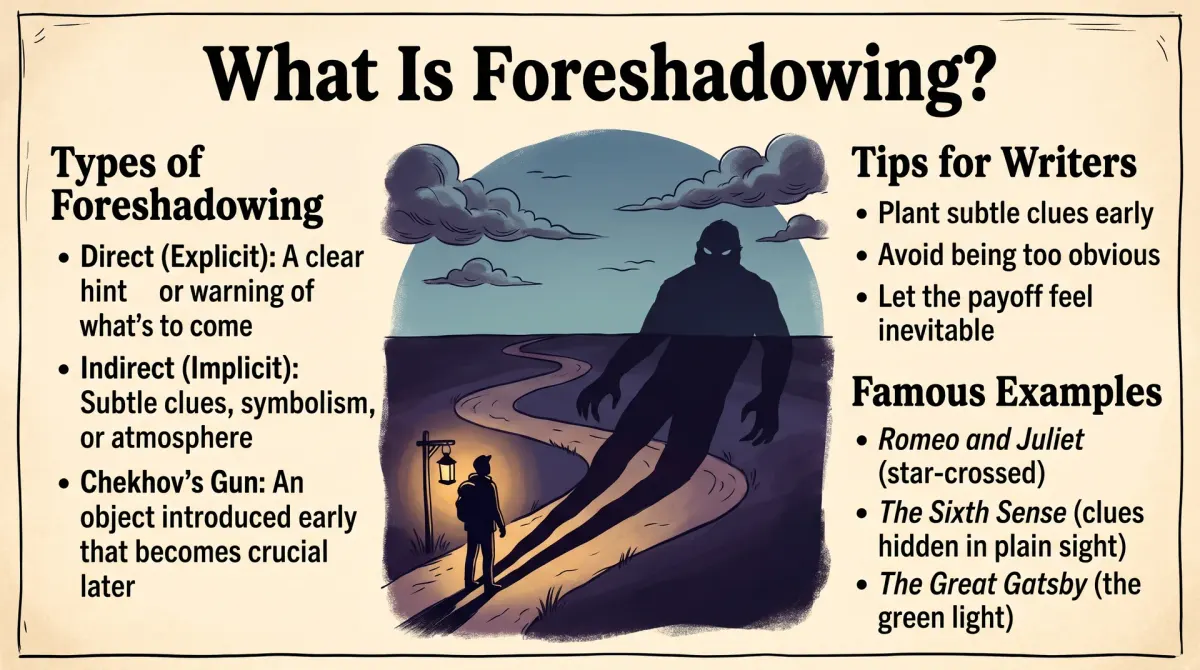
Foreshadowing is a literary device that gives hints about events to come. The hint may be a line of dialogue, an object, a setting detail or a mood. It prepares the reader for later events, so a twist, a loss or an ending feels earned and fair.
Foreshadowing works on a simple trade. The writer gives a small hint now. The reader gets a bigger payoff later. The hint should be easy to miss on a first read and clear on a second.
Merriam-Webster gives the dictionary meaning.
Foreshadowing does three jobs:
- Builds tension. The reader senses danger and waits for it.
- Makes twists fair. The clues were there all along.
- Adds unity. Early scenes link to late ones.
The word shows up in plays and films, too. A stage play may open with a line that warns of a fall. A film may show a gun early on.
Foreshadowing is a plot tool. It also shapes mood. A dark hint early can color a happy scene. If you plan your plot ahead, an outline helps you place hints.
Types of foreshadowing
Key takeaway: Hints can be direct or subtle. Use the type that matches your story's tone.
Writers sort foreshadowing into a few types.
| Type | How it works | Feel |
|---|---|---|
| Direct | States what may come | Bold |
| Indirect | Hints through detail | Quiet |
| Symbolic | Uses an image or object | Layered |
More types are worth knowing:
- Dialogue hints. A character says something that proves true later. "Nothing bad ever happens here."
- Setting and weather. A storm gathers before a loss.
- Chekhov's gun. An object is shown early and used later. The idea comes from advice linked to the playwright Anton Chekhov. A gun shown in act one should fire by act three.
- Flash-forward. The story jumps ahead for a glimpse of what is to come.
- Prophecy or dream. A character sees or hears a sign of the future.
- Title or prologue. The opening hints at the outcome.
A direct hint might read, "She would never see the house again." The reader knows a loss is coming. The tension is in how and when.
An indirect hint hides in detail. A character checks the lock twice. The reader may not notice, but the habit matters in chapter ten.
Direct hints suit tragedy and suspense. Indirect hints suit mystery and twists. Symbolic hints suit literary fiction.
Foreshadowing is not the same as a motif, though they can overlap. A motif repeats. A foreshadowing hint points ahead. A repeated image can do both.
Foreshadowing examples
Key takeaway: Strong examples are small on a first read and clear after the payoff.
Here are well-known cases.
- Romeo and Juliet. The opening of the play tells the audience that the lovers will die. The play then builds tension from knowing the end.
- Macbeth. The witches' words in the first act point to the king's rise and fall. Their predictions shape his choices.
- Harry Potter. Small details in early books, such as a character's odd behavior, pay off in later books. Readers often reread to spot them.
- The Hunger Games. Early scenes show skills, such as Katniss's use of a bow, that matter in the arena.
Notice what these share. The hint is tied to character or theme. It is not random. It also pays off in a way that feels both surprising and fair.
Short examples help. Here is a plant and its payoff:
Plant (chapter 2): Mara notices that the lighthouse door sticks in damp weather. She curses it and moves on.
Payoff (chapter 20): In the storm, the door sticks, and the villain is trapped inside.
The plant is small. The payoff is satisfying. The reader thinks, "Of course."
The plant-and-payoff ledger
Key takeaway: Track every hint and its payoff in a ledger so none is left unpaid.
Most articles list types and examples. Few give a way to manage hints. A simple ledger solves that.
Make a table with four columns: the plant, where it appears, the payoff and where it pays off. Fill it as you revise.
Here is a worked example for a 80,000-word novel. You list these plants.
- Plant A: the sticking door, chapter 2, pays off in chapter 20
- Plant B: a torn letter, chapter 5, pays off in chapter 18
- Plant C: Leo's scar, chapter 7, pays off in chapter 25
- Plant D: a locked drawer, chapter 9, no payoff yet
- Plant E: a stray dog, chapter 12, pays off in chapter 22
Count them: 5 plants. Count the payoffs: 4.
Payoff rate: 4 ÷ 5 = 0.80, or 80 percent.
The ledger shows one loose end: Plant D. Either pay it off or cut it. A locked drawer that never opens will annoy readers who noticed it.
Now check the spacing. The novel has 40 chapters, so each chapter is about 2,000 words. Plant A in chapter 2 pays off in chapter 20. That is 18 chapters, or 36,000 words, apart. That is a long gap, which suits a major twist. A short gap of two or three chapters suits a smaller hint.
Use a mix. Short gaps keep tension. Long gaps give the biggest payoffs.
The ledger works in revision, too. After you finish a draft, you know the ending. Go back and add plants for what you wrote late. This is how most writers work.
A longer guide to writing a novel shows where revision fits into the process.
How to add foreshadowing step by step
Key takeaway: Start with the ending, then plant hints backward.
Use these steps to add foreshadowing in revision.
- List the key events of the ending.
- Pick three to five events to foreshadow.
- Write a plant for each, early in the book.
- Hide each plant inside action or detail.
- Log each plant in your ledger.
- Check that every plant pays off.
- Read the book once for subtlety.
Step four is the craft. A plant should not shout. Bury it in a scene where the reader's eye is elsewhere. A hint in the middle of a long paragraph is easier to miss than one at the end.
Step seven is a test. Ask a friend to read and mark spots where they feel a hint. If they spot too many, the hints are heavy. If they spot none, the hints may be too faint. Aim for a few felt but not named.
Vary your methods. Use a line, an object and a setting. If all hints use the same device, readers learn to spot them.
Also guard against false hints. A red herring is a clue that points the wrong way. It is useful in mystery. But it should be fair. It must have a reason to be in the story.
Foreshadowing vs red herring vs flash-forward
Key takeaway: Foreshadowing points to the truth. A red herring points away. A flash-forward shows the future.
These devices look alike but work in different ways.
- Foreshadowing hints at what will really happen.
- A red herring hints at something false, to mislead.
- A flash-forward jumps to a later time to show an event.
- A teaser opens with a scene from later, then returns to the start.
Each has a place. A mystery may use all of them. Foreshadowing adds the real clues. Red herrings add noise. A teaser may open with the crime scene.
Too many red herrings can frustrate readers. Aim for a clear ratio. In a mystery with 10 clues, a balance might be 6 true hints and 4 false ones. That is 6 ÷ 10 = 60 percent true. The shares are a planning example, not a rule.
A fair mystery lets the reader solve the case with the clues given. If the solution rests on a hint you never planted, the book breaks fair play.
People Also Ask
What is an example of foreshadowing?
The opening of Romeo and Juliet tells the audience that the lovers will die. Another example is a sticking door in chapter two that traps the villain in chapter twenty. A good example is small when read first and clear after the payoff.
What is the difference between foreshadowing and a red herring?
Foreshadowing hints at what will really happen. A red herring is a false clue that points the wrong way. Both create tension. A fair story uses red herrings with care. Each needs a reason to be in the book, and none should cheat the reader.
Can you foreshadow in a short story?
Yes. A short story has little room, so one or two hints are enough. A single object or line can set up the ending. Because the story is short, the hint is close to the payoff. Keep the hint subtle but fair.
Common mistakes
- Planting a hint that never pays off.
- Making hints so obvious that the twist is no surprise.
- Using only one device, so readers learn to spot it.
- Adding red herrings with no reason to exist.
- Planting hints that break the story's own rules.
Your next step: build your ledger
Open your draft and list five hints. Log where each is planted and where it pays off. Check the payoff rate. Fix any loose end by paying it off or cutting it.
For a smaller form, read the short story guide. It shows how to plan hints in fewer pages.