What is flash fiction?
Key takeaway: Flash fiction is a complete story in a very small space.
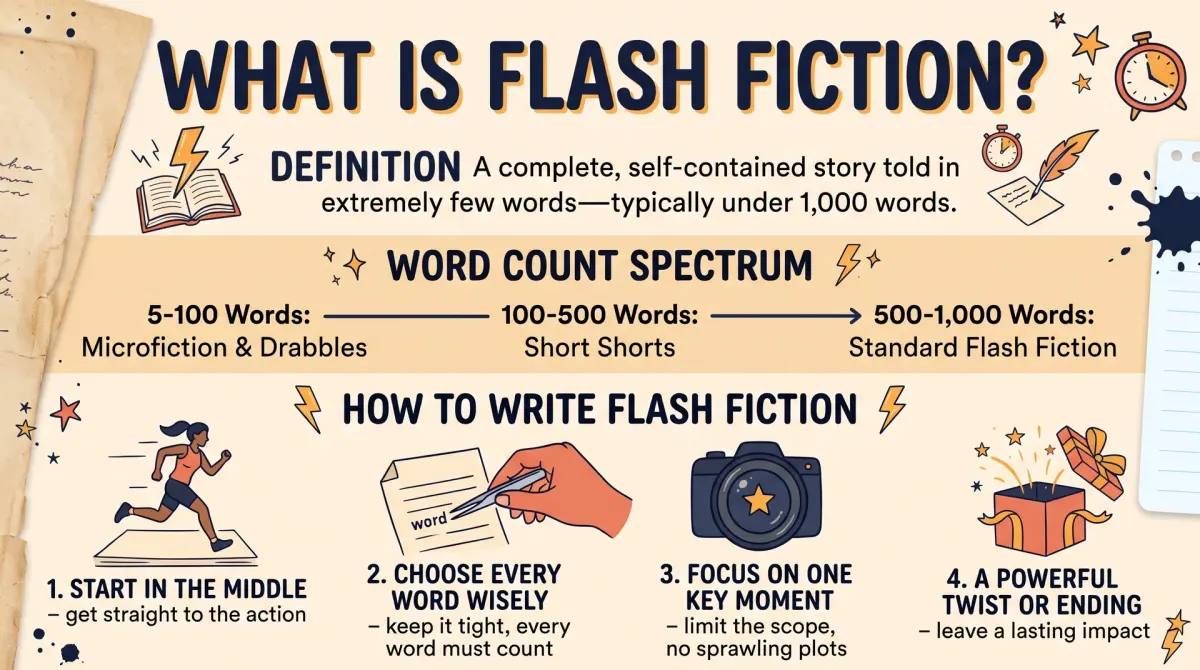
Flash fiction is a style of fiction that tells a complete story in very few words, often under 1,000. It has a character, a moment of change and an ending. Because of its length, it relies on hints, strong images and a sharp final beat.
Merriam-Webster lists the term in its dictionary.
Flash fiction is also called sudden fiction or short-short stories. Labels vary by writer and journal.
A flash story differs from a scene or a sketch. A scene is a part of a story. A sketch paints a mood. A flash story has a full arc, though the arc may be small.
It needs three things:
- A character. Someone the reader can see.
- A change. Something shifts by the end.
- An ending. The story closes, even if it leaves a question.
The form uses implication. The writer shows part of the story and trusts the reader to fill in the rest. A line like "she put the second plate away for good" tells a long tale in a few words.
If you want to write longer forms later, flash fiction is a good warm-up. It trains you to cut and to choose.
Flash fiction word counts and labels
Key takeaway: Labels depend on length, and the cutoffs vary by journal.
Very short fiction has several names.
| Form | Length |
|---|---|
| Six-word story | Exactly 6 words |
| Drabble | Exactly 100 words |
| Micro fiction | Often under 300 words |
| Flash fiction | Often under 1,000 words |
The six-word story is the shortest. It tells a tale in six words. The drabble is a story of exactly 100 words. It is a fun test of control.
Micro fiction and flash fiction have looser limits. Some journals cap flash at 500 words. Others allow up to 1,500. Always read the rules before you submit.
How does flash fiction compare with longer forms? A short story often runs a few thousand words. A novel runs tens of thousands. For genre length norms, see the word count guide.
Choose a length by your story. A single moment fits 100 words. A small journey may need 800.
A sample flash story, broken down
Key takeaway: Even 52 words can hold a setup, a build and a turn.
Here is a complete story of 52 words.
Mara set the table for two. She lit the candle, poured the wine, and waited. At nine, the phone buzzed. A text: Running late. At ten, another: Sorry. At midnight she blew out the candle. Then she took the second plate to the sink, washed it, and put it away for good.
Now count the parts.
- Setup: words 1 to 15. This part gives the character, the scene and the want.
- Build: words 16 to 35. Two texts raise the pressure.
- Turn: words 36 to 52. She makes a quiet choice.
Check the totals: 15 + 20 + 17 = 52 words.
Share of the story:
- Setup: 15 ÷ 52 = about 29 percent
- Build: 20 ÷ 52 = about 38 percent
- Turn: 17 ÷ 52 = about 33 percent
The shares are fairly even. That keeps the story in balance. If the setup took 40 words, the story would feel slow.
Notice what the story leaves out. It never says she is sad. It never names the missing person. The reader infers both. That is implication at work.
Notice also the objects. The candle, the wine and the plate carry the feeling. Strong objects are a flash writer's best tool.
Techniques that work in tiny spaces
Key takeaway: Use objects, silence and strong verbs to say more with less.
A few tools do heavy work in short fiction.
- Use one object. A key, a coat or a plate can carry a whole feeling. In the sample story, the second plate does this.
- Use silence. Let characters avoid the real topic. The gap between what they say and what they mean creates tension.
- Use strong verbs. "She slammed the drawer" beats "She closed the drawer angrily."
- Use a tight time frame. One evening, one drive or one phone call sets clear limits.
- Use the title. The title can add a clue the text leaves out.
Show, do not tell. Compare two lines.
- Tell: "She was angry." This uses 3 words.
- Show: "She snapped the pencil in two." This uses 6 words.
The second line costs three more words. It also shows the feeling and gives the reader something to see.
Watch your dialogue budget. In a 500-word story, five short lines of about 10 words each use 50 words. Check: 5 × 10 = 50. That is 50 ÷ 500 = 10 percent of the story.
Keep each line sharp. In flash fiction, speech must reveal character or move the plot. If a line does neither, cut it.
How to cut a draft: a 20 percent exercise
Key takeaway: Write long, then cut. Trimming 20 percent often sharpens a draft.
Most flash writers cut more than they add. This exercise gives you a target.
Say your journal allows 500 words. Your draft runs 625 words.
- Words to cut: 625 − 500 = 125
- Cut share: 125 ÷ 625 = 0.20, or 20 percent
So you must cut one word in five. Where do you look?
Cut first:
- Extra adjectives and adverbs
- Backstory the reader can guess
- Dialogue tags such as "she said", when the speaker is clear
- Repeated ideas
- A slow opening
Keep:
- The one image that carries the feeling
- The turn
- The last line
Try it in passes. Pass one: cut 50 words of throat-clearing. Pass two: cut 50 words of repeated ideas. Pass three: cut 25 words from line edits. Check: 50 + 50 + 25 = 125 words.
After each pass, read the story aloud. If a cut hurts the sense, put it back. The goal is not the fewest words. It is the right words.
A word-count tool can track your progress. Keep the count in view as you edit.
How to write flash fiction step by step
Key takeaway: Pick one moment, one character and one change. Then cut.
Use these steps to write one.
- Pick one moment, not a whole story.
- Choose one character and one want.
- Open in the middle of the action.
- Show one turn or change.
- End on an image or a twist.
- Cut every word that does no work.
Step one is the secret. A flash story cannot hold a life. It can hold an hour, a phone call or a single choice.
Step three saves words. Start where the tension begins. Skip the morning routine, the weather and the long introduction.
Step five matters most. The last line should land. It can be an image, a line of dialogue or a small reversal. Try writing three endings, then pick the one that leaves the strongest mark.
Avoid the cheap twist. A twist that depends on a dream or a trick can feel like a letdown. A good ending feels both surprising and fair.
Last, give your piece a title that works. In flash, the title is part of the story. It can add a clue, a place or a mood. A title tool can help you test ideas.
What to do with flash fiction
Key takeaway: Flash suits journals, contests, social media and collections.
Once you have a piece, you have options.
- Submit to journals. Many literary magazines take flash fiction. Read their rules and word limits.
- Enter contests. Some contests focus on very short work.
- Post online. A blog or social account works well for short pieces.
- Build a collection. Several flash stories can form a book.
Here is a worked example of a collection. You write 40 stories of 500 words each.
- Total: 40 × 500 = 20,000 words
At 250 words per page, 20,000 ÷ 250 = 80 pages. That is a slim book. You may add art, notes or a few longer pieces to reach a fuller length.
If you plan to self-publish, a checklist helps.
Some writers also gather flash fiction by many authors into anthologies. That can be a way to start a small press or a writing group project.
People Also Ask
How long is flash fiction?
Flash fiction is usually under 1,000 words, though the limit varies by journal. Some cap flash at 500 words. Shorter labels include the drabble, at exactly 100 words, and the six-word story. Always check the rules of the market where you plan to submit.
What is the difference between flash fiction and a short story?
A flash story is much shorter, often under 1,000 words. A short story usually runs a few thousand words. Flash fiction relies on hints and strong images, while a short story has room for more scenes and detail. Both need a character, a change and an ending.
How do you start writing flash fiction?
Pick one moment and one character with a want. Open in the middle of the action to save words. Show one turn or change, and end on a strong image or a fair twist. Write a draft a little long, then cut about 20 percent.
Common mistakes
- Trying to tell a whole life in 500 words.
- Opening with slow setup and backstory.
- Ending on a cheap twist.
- Leaving out the change.
- Cutting by count without reading the story aloud.
Your next step: write a 100-word story
Pick a moment. Write a draft of about 125 words. Cut 20 percent, which is 25 words, to reach 100. Read it aloud and check that it has a character, a change and an ending.
When you are ready for more room, try a full short story.