What is conflict in a story?
Key takeaway: Conflict is the struggle that stands between a character and a goal.
Conflict in a story is a struggle between a character and something that blocks a goal. The opposing force may be another person, the character's own fear, society, nature, technology or the supernatural. Conflict creates tension, drives the plot and forces the character to make choices.
Conflict is not the same as an argument. A fight in a kitchen is one form, but not the only one. A storm that traps a hiker is conflict. A secret that the lead cannot admit is conflict too.
Every conflict needs three parts:
- A goal. The lead wants something.
- An obstacle. Something blocks the goal.
- Stakes. The lead will lose something if they fail.
If one part is missing, the tension drops. A lead with a goal but no obstacle walks straight to the end. A lead with an obstacle but no stakes has no reason to care.
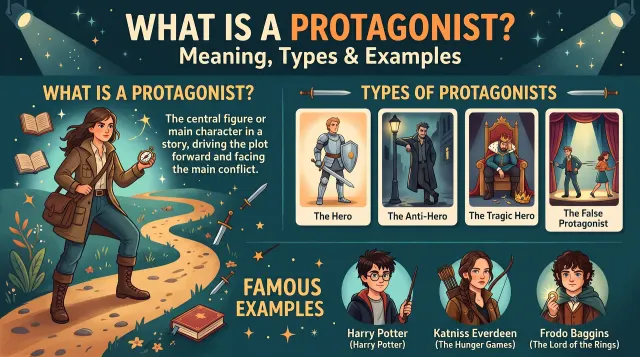
The lead of the story is called the protagonist. The force that blocks the lead is the antagonist. In some stories the antagonist is a person. In others it is a force such as weather or fear.
Merriam-Webster gives a short dictionary meaning of conflict in literature.
Understanding the lead and the opposing force is the first step to planning conflict. The guide on character roles can help.
Internal vs external conflict
Key takeaway: External conflict happens between the lead and the world. Internal conflict happens inside the lead.
Writers split conflict into two broad groups.
External conflict is a struggle between the lead and an outside force. This could be a person, a group, nature or a machine. The reader can see it happen.
Internal conflict is a struggle inside the lead's mind. It could be fear, guilt, doubt or a hard choice. The reader sees it through thought and action.
| Group | Types | Where it happens |
|---|---|---|
| External | Person, society, nature, technology, supernatural | Outside the lead |
| Internal | Self | Inside the lead |
Strong stories often use both. The external conflict drives the plot. The internal conflict gives it meaning. For example, a lead may fight a rival to win a race. The deeper battle is the fear of failing a parent.
A good test is to ask two questions. First, what does the lead want? That is the outer goal. Second, what does the lead need? That is the inner lesson. When want and need clash, you have both types at once.
The six types of conflict
Key takeaway: The six common types are person, self, society, nature, technology and the supernatural.
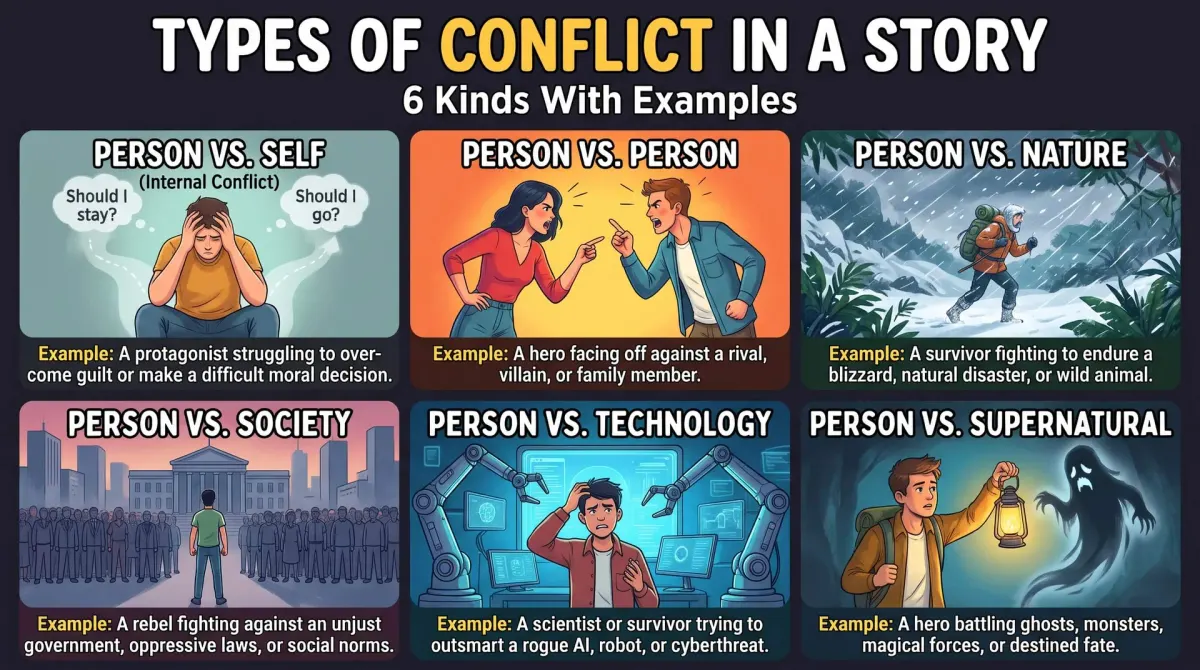
Here are the six types with plain examples.
1. Character vs character. One person works against another. This is the most common form. Harry Potter sets Harry against Voldemort. A rivalry, a feud or a courtroom fight also fits here.
2. Character vs self. The lead fights fear, doubt, guilt or temptation. In Hamlet, the prince struggles to act on what he knows. This is internal conflict.
3. Character vs society. The lead pushes against rules, customs or a system. In 1984, Winston Smith defies a state that controls thought. In The Hunger Games, Katniss fights a system that forces children to fight.
4. Character vs nature. The lead struggles against the natural world. A storm, a desert, a mountain or a sea can all be the opponent. The Old Man and the Sea shows a fisherman against a great fish and the ocean.
5. Character vs technology. The lead faces a machine, a program or a tool that has turned against people. This type is common in science fiction. Frankenstein is often read as a story of a creator against his own invention.
6. Character vs the supernatural. The lead faces a ghost, a god, a curse or a monster. Horror and fantasy use this type often. Dracula sets human characters against a vampire.
For plot summaries of classic works named here, Britannica offers free reference pages.
Some lists name a seventh type, character vs fate. This is the struggle against destiny. Others treat it as part of the supernatural or the self.
These six are guides, not strict boxes. A story can fit two types at once. A ghost story can be character vs the supernatural and character vs self if the lead fears the truth.
How to choose a conflict for your story
Key takeaway: Match the conflict to your theme. The struggle should ask the story's main question.
Most pages list the types and stop. A better step is to choose with care. Use this simple link between type and question.
| Conflict type | Story question | Fits best with |
|---|---|---|
| Character vs character | Who will win? | Thriller, mystery |
| Character vs self | Can they change? | Literary, drama |
| Character vs society | Is the system just? | Dystopian, historical |
The same logic applies to the other three. Nature asks whether the lead can survive. Technology asks what we owe the things we make. The supernatural asks what lies beyond the world we know.
Pick the main type first. Then add a second type as support. A survival story may be nature as the main conflict, with self as the support. The lead battles a storm while fighting the urge to give up.
Next, check the stakes. Ask what the lead loses if they fail. Stakes can be life, love, freedom, honor or money. The higher the stakes, the more the reader cares. Raise them in the middle of the book so tension grows.
If you are still planning, an outline can help you place the main conflicts across the story.
A scene check for conflict
Key takeaway: Tally the conflict in each scene. A scene with none is a candidate to cut or rework.
Here is a quick check that few articles offer. Go through your draft scene by scene. Write down the main conflict type in each one. Mark any scene with no conflict.
Here is a worked example for a draft with 30 scenes.
- Character vs character: 12 scenes
- Character vs self: 8 scenes
- Character vs nature: 6 scenes
- No clear conflict: 4 scenes
Check the total: 12 + 8 + 6 + 4 = 30 scenes.
Now work out the shares.
- Person: 12 ÷ 30 = 0.40, or 40 percent
- Self: 8 ÷ 30 = about 0.27, or 27 percent
- Nature: 6 ÷ 30 = 0.20, or 20 percent
- None: 4 ÷ 30 = about 0.13, or 13 percent
The draft leans on conflict between people. That is a good sign for a thriller. The 13 percent of scenes with no conflict is the area to review.
For each of the four scenes, ask three questions:
- What does the lead want in this scene?
- What stops them?
- What changes by the end?
If you cannot answer, the scene may be filler. Cut it, merge it into another scene or add an obstacle. A quiet scene can still have conflict. A tense dinner is a quiet scene with a strong struggle.
This check is not a law. Some scenes set up a world or give the reader a rest. Keep these if they earn their place. Treat the shares as a mirror for your own draft, not as a target.
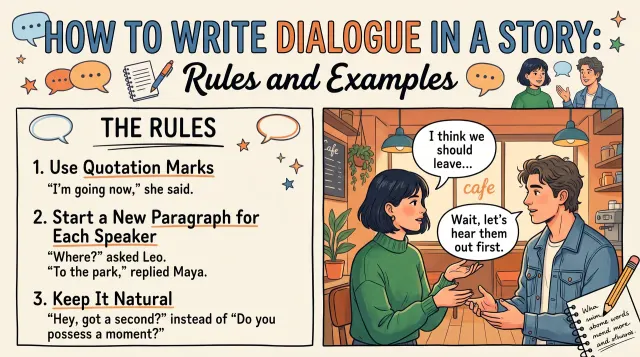
A similar check applies to dialogue. Each exchange should include a clash of wants, even if it is small.
Conflict and the plot
Key takeaway: Conflict rises in steps from the start to the climax, then resolves.
Conflict is the engine of plot. A classic shape has five stages:
- Setup. The lead and the goal appear.
- Rising action. Obstacles grow and stakes rise.
- Climax. The conflict peaks, and the lead faces the biggest test.
- Falling action. The results of the climax unfold.
- Resolution. The conflict ends, and the new normal appears.
Each stage needs conflict, but the intensity differs. Early scenes can use small clashes. The middle should raise the cost. The climax should force a hard choice.
The same applies to subplots. A subplot has its own conflict, often a different type from the main line. This variety keeps the book fresh. Conflicts in a series can last across books. A big enemy may take three books to defeat.
Short stories use the same shape in miniature. One conflict, one turning point and a quick resolution are enough. A short guide can show how to scale the plan.
People Also Ask
What are the 4 main types of conflict?
Many classroom lists use four types: character vs character, character vs self, character vs society and character vs nature. Longer lists add character vs technology and character vs the supernatural, for six in total. Both lists describe the same idea, with some types grouped together.
What is the difference between internal and external conflict?
External conflict is a struggle between the lead and an outside force, such as a person, a society or nature. Internal conflict is a struggle inside the lead, such as fear or guilt. Strong stories often use both, with the external conflict driving the plot.
Can a story have more than one conflict?
Yes. Most stories do. A novel may have a main conflict and several smaller ones in subplots. A lead can fight a rival while also fighting doubt. Layered conflicts add depth. The key is to keep one main conflict clear so the reader knows what matters most.
Common mistakes
- Writing scenes where nothing blocks the lead's goal.
- Using only external conflict, so the lead never changes.
- Making the antagonist too weak to threaten the lead.
- Raising stakes too late in the book.
- Mixing so many conflicts that the main one is unclear.
Your next step: tally your scenes
Open your draft and list each scene. Mark the main conflict type in each. Use the 30-scene example as a model. Then fix scenes with no conflict by adding a goal and an obstacle.
If you are starting a new book, pick your main conflict before you write. A clear struggle makes the rest of the plan much easier.