What is a foil character?
Key takeaway: A foil is a character whose contrast makes another character clearer.
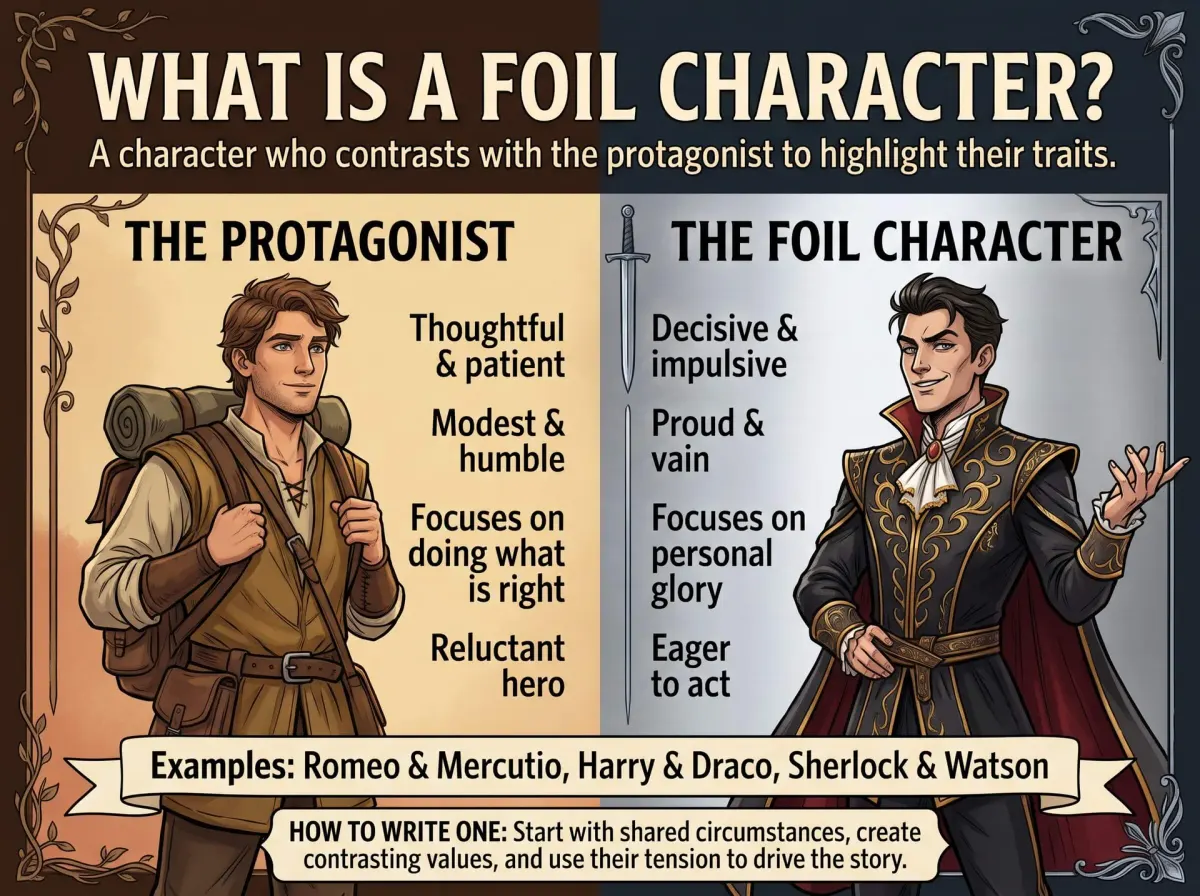
A foil character is a character whose traits, choices or values contrast with those of another character, usually the protagonist. The contrast highlights the qualities of both. A foil may be a friend, rival or villain. It works best with its own goals and depth.
The term comes from jewelry. A jeweler once set a gem on a thin sheet of shiny metal called foil. The backing made the stone gleam. In a story, a foil does the same for a character.
Merriam-Webster lists the figurative meaning of foil.
A foil can contrast in many ways:
- Personality. Bold versus shy.
- Values. Honest versus deceitful.
- Goals. One wants peace and the other wants power.
- Methods. One uses logic and the other uses feeling.
- Background. Wealth versus poverty.
The contrast should reveal something. A foil does not exist only to look different. It exists so the reader sees the lead more clearly.
A foil is a type of supporting character. If you want to see how roles fit together, a guide to character types can help.
Foil vs antagonist vs sidekick
Key takeaway: A foil contrasts. An antagonist opposes. A sidekick supports. One character can be more than one.
These roles overlap. They are not the same.
| Role | Main job | Relationship to lead |
|---|---|---|
| Foil | Contrast | Friend, rival or foe |
| Antagonist | Oppose the goal | Enemy or force |
| Sidekick | Support the lead | Ally |
An antagonist blocks the lead's goal. A foil may or may not. In Harry Potter, Draco Malfoy is both a foil and a rival. He is proud and cruel, while Harry is humble and loyal. In Sherlock Holmes, Dr. Watson is a foil who is warm and ordinary next to Holmes's cold genius. Watson is also an ally.
A sidekick helps the lead. Many sidekicks are foils, but not all. A sidekick who is just like the lead adds little contrast.
A character can be a foil without any link to the plot. In Pride and Prejudice, Elizabeth Bennet is often compared with her sister Jane and her friend Charlotte Lucas. Their different choices about love and money shed light on Elizabeth's own views. This reading is common among readers, though not the only one.
Also note that foils do not need to be human. A pet, a city or a machine can be a foil if it contrasts with the lead. The key is the contrast, not the form.
How to design a foil character
Key takeaway: Start from the lead's traits. Make the foil differ on the traits that matter most.
Most pages list examples but not method. A short design process helps you build a foil on purpose.
Here is a worked example of a trait-contrast score. Your lead, Mara, has five key traits. List the opposite or a different value for the foil, Leo.
| Trait | Mara | Leo |
|---|---|---|
| Risk | Takes risks | Avoids risks |
| Honesty | Blunt | Tactful |
| Money | Spends | Saves |
Add two more traits for the full list of five:
- Planning: Mara improvises, Leo plans.
- Trust: Mara trusts quickly, Leo trusts slowly.
Now score each trait. Give one point if the traits contrast clearly. Give zero if they match.
- Risk: 1
- Honesty: 1
- Money: 1
- Planning: 1
- Trust: 1
Total: 1 + 1 + 1 + 1 + 1 = 5 out of 5.
Contrast score: 5 ÷ 5 = 100 percent.
That is too neat. Real people share many traits. A foil who differs on every point can feel like a cartoon. A better aim is about 60 percent contrast. For five traits, that is 3 of 5.
So make two traits the same. Let both love their town. Let both fear failure. Shared traits make the pair feel real. The three contrasts carry the effect.
Choose the contrast that ties to your theme. If the theme is trust, the trust trait should be strongest. Put your focus there.
If you want to refine each character's traits, a list can speed up the work.
How to write a foil step by step
Key takeaway: Give the foil a goal, a flaw and a reason to be in the scene.
Use these steps to build a foil with depth.
- List the lead's five main traits.
- Choose three to contrast.
- Keep two traits the same.
- Give the foil a clear goal.
- Give the foil a flaw and a strength.
- Put both in scenes with a shared choice.
- Check that the contrast reveals something.
Step four matters most. A foil with no goal is a mirror. Readers sense it. Give the foil something to want, even if the want is small.
Step six is where the effect shows. A foil works best when both characters face the same problem. They choose in different ways. The reader sees how their traits shape the result.
Here is a tiny scene. A bridge is down, and the two must cross.
Mara looked at the gap. "We jump."
Leo checked the rope. "We build."
In two lines, the reader sees two minds. No narration is needed.
Keep the foil sympathetic. A foil who is only wrong makes the lead look smug. Give the foil a fair point. Sometimes the foil should be right.
Famous foil examples
Key takeaway: Strong foil pairs share a world and a goal but differ in method and values.
Here are examples that many readers know.
- Sherlock Holmes and Dr. Watson. Holmes is cold and brilliant. Watson is warm and plain. Watson also acts as the reader's guide.
- Harry Potter and Draco Malfoy. Harry is humble, while Draco is proud. Both are young wizards who start at the same school.
- Katniss Everdeen and Peeta Mellark. Katniss is hard and wary. Peeta is open and kind. Their pairing shows two ways to survive.
- Frodo and Gollum. Both carry the Ring. Frodo resists its pull, and Gollum gives in. Gollum shows what Frodo could become.
The last pair shows a darker use of a foil. A foil can be a warning. It shows the lead the road not taken.
Foils appear across forms. In film, buddy comedies pair an uptight person with a free spirit. In TV, a calm boss may face a chaotic worker. The pattern is the same.
Foils beyond the lead
Key takeaway: Foils can pair any two characters, not just the lead and a rival.
Most guides focus on the lead. Yet foils work across the whole cast. Two side characters can be foils to each other. Two villains can too.
Take a villain pair. One is cold and plans every move. The other is hot-tempered and acts on impulse. Each makes the other look more extreme. The reader sees two kinds of danger.
A foil can also be a mirror. A mirror foil shares the lead's goal and background but makes a different choice. Gollum and Frodo fit this idea. Both carry the Ring, but they respond in different ways. The mirror shows the lead what could happen.
Use a foil to show change, too. A character's foil at the start may become their ally at the end. The shift shows growth. Place a scene early where the two disagree. Place a scene late where they agree. The gap between them measures the arc.
In a series, foils can run across books. A rival in book one may appear as a mentor in book three. That long arc takes planning. Keep a short note on each pair and how they change.
Last, mind the page count. In a 90,000-word novel, a main foil might appear in about 20 percent of scenes. At 30 scenes of 3,000 words each, that is 30 × 0.20 = 6 scenes. This is a planning idea, not a rule. Fewer scenes can work if each one counts.
People Also Ask
What is the purpose of a foil character?
A foil highlights the traits of another character through contrast. It helps readers see the lead more clearly. It can also reveal theme, create conflict or show a path the lead could take. A good foil also moves the plot, not just the mood.
Is a foil always the antagonist?
No. A foil can be a friend, ally, rival or enemy. The key is contrast, not opposition. An antagonist blocks the lead's goal. A foil may help, hinder or do neither. Some characters are both foil and antagonist, such as a rival who differs sharply from the lead.
Can a story have more than one foil?
Yes. A lead may have several foils, each contrasting on a different trait. One may differ in values, another in method. Too many can clutter the cast. Give each foil a clear purpose, and avoid repeating the same contrast in the same story.
Common mistakes
- Making the foil a perfect opposite on every trait.
- Giving the foil no goal of their own.
- Making the foil only wrong, so the lead looks smug.
- Adding a foil who never shares a scene with the lead.
- Using the foil to explain the lead out loud.
Your next step: score your pair
Pick your lead and a second character. List five traits for each. Score the contrast, as in the example. Aim for about three contrasts out of five. Adjust one trait that is too close.
Then write one scene with both facing the same problem. Read it to see whether the contrast shows.