What is exposition in writing?
Key takeaway: Exposition gives the reader the background needed to follow the story.
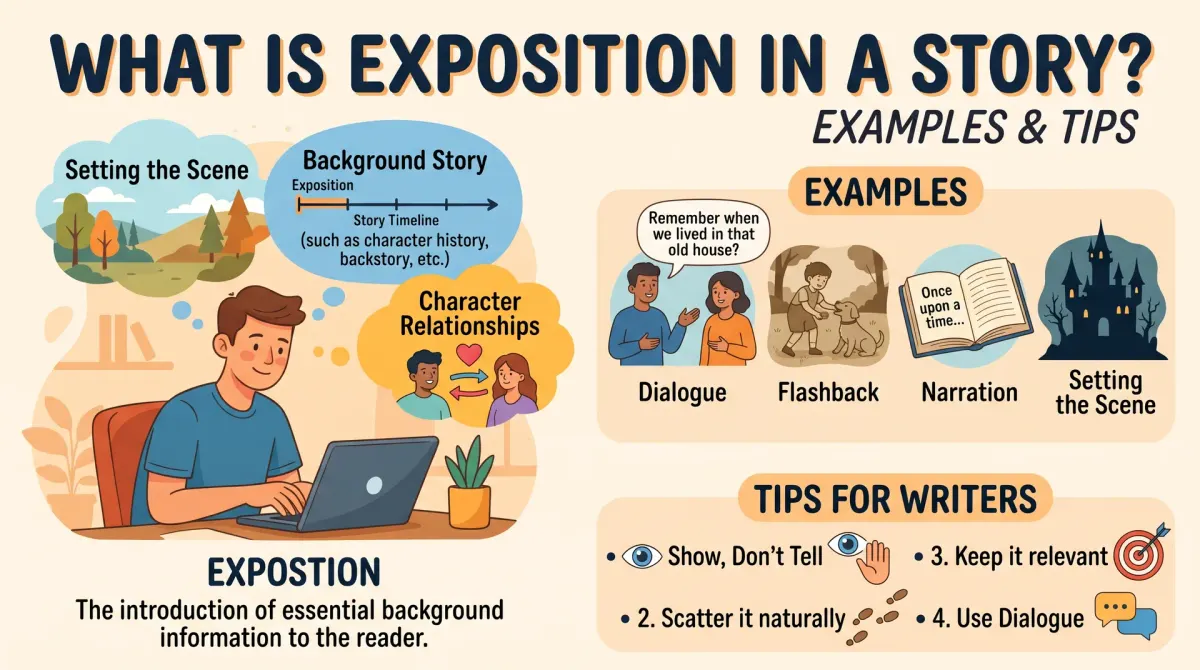
Exposition is the background information that helps a reader understand a story. It tells who the characters are, where and when the story takes place, and what happened before the plot begins. The word also names the first stage of a classic plot, where this setup appears.
Exposition answers basic questions. Who is this? Where are we? What do they want? What happened before? A story cannot work without some of those answers.
Merriam-Webster lists the literary meaning of the word.
The word has two uses in writing. First, it names the information itself. Second, it names the opening stage of a plot. In the classic five-part shape, exposition comes first, then rising action, climax, falling action and resolution.
Exposition is not the same as description. Description paints a scene. Exposition explains what the reader needs to know. A line like "The house had peeling paint" is description. A line like "The house had been empty since the fire" is exposition, because it gives history.
Exposition also differs from backstory. Backstory is the full past of a character or world. Exposition is the part of it that the reader gets on the page. Writers often know far more backstory than they share.
Good exposition feels invisible. The reader learns things without noticing they are being taught.
Exposition is strongest when it ties to the plot. If you are still planning how the story begins, an outline can show where setup is needed.
Methods of exposition
Key takeaway: Pick the method that fits the moment. Mix methods to keep the page lively.
Writers use a handful of methods to share background. Each has strengths and risks.
| Method | How it works | Risk |
|---|---|---|
| Narration | The narrator explains | Can feel like a lecture |
| Dialogue | Characters talk | Can sound unreal |
| Documents | Letters, news, notes | Can feel staged |
Other methods also work:
- Action. A character does something that reveals history. A woman flinches at a siren, and the reader senses a past event.
- Setting detail. A ruined wall, a faded photo or a locked room hints at what came before.
- Thought. A close point of view lets a character remember at the right moment.
- Flashback. A short scene from the past shows what happened.
- Prologue. A short opening section can set up key facts.
Dialogue deserves care. A common mistake is "As you know, Bob" talk. Two characters tell each other facts they both already know, just for the reader. Avoid it. Let characters speak only about what they need to say.
A better use of dialogue is conflict. Two characters argue about the past, and the reader learns the history through the clash.
Many authors use a prologue for setup. A guide to prologues explains when this works and when it slows the book.
Exposition examples
Key takeaway: The best exposition hides inside action, conflict and detail.
Here is a weak example, followed by a stronger one.
Weak (info dump):
Mara was twenty-six years old. Her father had left when she was ten. Her mother had raised her alone in a small town by the sea, where they ran a bakery. Mara had always wanted to leave.
Stronger (woven in):
Mara counted the loaves twice, the way her mother had taught her after Dad left. The bakery smelled of sugar and salt. Outside, the sea bit at the pier. Each morning she wished the bus out of town ran earlier.
What changed? The second version uses action and detail. Mara counts loaves. The reader learns about the father, the mother, the bakery, the town and Mara's wish. No fact is announced. Each fact sits inside a moment.
Film often uses a quick trick: an opening crawl or a voice-over. It works because the audience agrees to be told. In a novel, the same approach can feel flat, unless the voice is strong.
Another strong method is the question hook. Raise a question, then answer it later. A mention of "the night of the fire" makes the reader want to know more. Hold back the answer until the story needs it.
How much exposition is too much?
Key takeaway: Keep exposition to a small share of any scene, and spread the rest across chapters.
Most articles tell you to avoid info dumps but give no numbers. A simple budget gives you a starting point. It is a rule of thumb, not a law.
Here is a worked example for an opening chapter of 3,000 words.
- Exposition budget: about 10 percent of the chapter
- Calculation: 3,000 × 0.10 = 300 words
So the chapter can hold about 300 words of pure background. The rest should be action, dialogue and conflict.
Now check a draft. Say your first chapter has 900 words of backstory.
- Share of the chapter: 900 ÷ 3,000 = 0.30, or 30 percent.
- Excess over budget: 900 − 300 = 600 words.
That is three times the budget. You can trim or move 600 words.
Next, build a drip plan. Break the 600 extra words into four pieces of 150 words each. Place one piece in each of chapters two to five.
- Chapter 2: 150 words
- Chapter 3: 150 words
- Chapter 4: 150 words
- Chapter 5: 150 words
Check the total: 4 × 150 = 600 words. Nothing is lost. The reader still gets all the background, but in small doses and at the moment it matters.
The share can vary by genre. Fantasy and science fiction often need more setup for the world. Even so, spread it out. A reader who learns the map in chapter one may forget it. A reader who learns it when a character needs a road remembers.
A related guide covers how long chapters tend to run, which helps with planning.
How to fix an info dump step by step
Key takeaway: Cut what the reader does not need yet, then move the rest to where it matters.
Use these steps on any block of heavy background.
- Highlight every sentence of pure background.
- Mark facts the reader needs right now.
- Cut facts the reader does not need yet.
- Move other facts to later scenes.
- Turn key facts into action or dialogue.
- Add a conflict that makes the fact matter.
- Reread the scene for flow.
Step two is the key. Ask of each fact, "Does the reader need this now?" If the answer is no, it can wait.
Step six lifts the whole scene. A fact lands harder when it causes trouble. If a character must hide her past, the reader will read each hint with care.
Be brave about cutting. Many writers hold on to backstory because it cost them effort. The reader does not need to know the cost. A fact that is cut can still shape the character from the shadows.
Keep a separate file for backstory. It can hold your notes, maps and timelines. You can draw from it as needed. The file is for you. The reader gets only the best pieces.
Exposition in different genres
Key takeaway: Fantasy and science fiction need more setup, but the same rules of pacing apply.
Genre changes how much the reader needs to know.
- Contemporary fiction. Readers know the world. Exposition can focus on character and history.
- Historical fiction. Readers may need dates, places and customs, but should not feel they are in a classroom.
- Fantasy and science fiction. Readers need rules for magic, technology or society. Share them through use, not through lectures.
- Mystery. Exposition is the clue trail. Each fact must be fair and findable.
- Memoir. The narrator explains the past in a natural voice, in the first person.
In worldbuilding genres, use the iceberg rule. The reader sees the tip. You know the rest. A strong tip hints at the depth below.
Short stories need the least exposition. There is little room, so every line must work. A guide for beginners shows how to start fast.
People Also Ask
What is exposition in a plot?
Exposition is the first stage of a classic plot. It introduces the characters, the setting and the starting situation. It also hints at the main conflict. After exposition come rising action, climax, falling action and resolution. Many modern stories blend exposition into the first scenes rather than separating it.
What is an info dump?
An info dump is a long block of exposition that stops the story. It tells the reader a lot of background at once, often in narration or dialogue. It slows pace and can bore readers. The fix is to cut what is not needed and spread the rest across scenes.
Where does exposition go in a novel?
Exposition appears mostly in the opening but should continue in small pieces across the book. Place each piece where the reader needs it, ideally inside action or conflict. Avoid stacking it all in chapter one. A drip plan across the first few chapters keeps the pace steady.
Common mistakes
- Stacking all the backstory in the first chapter.
- Using "As you know" dialogue to inform the reader.
- Explaining facts the reader can guess.
- Telling the rules of a world in one long speech.
- Starting with the past instead of a moment of action.
Your next step: run the 10 percent check
Pick your first chapter. Count the words of pure background. Divide by the chapter's word count. If the share is above 10 percent, trim or move the extra using the drip plan.
If the opening still feels slow, the novel guide shows how to start with a scene that grabs the reader.