What is a motif in writing?
Key takeaway: A motif is a repeated element that builds a theme through accumulation.
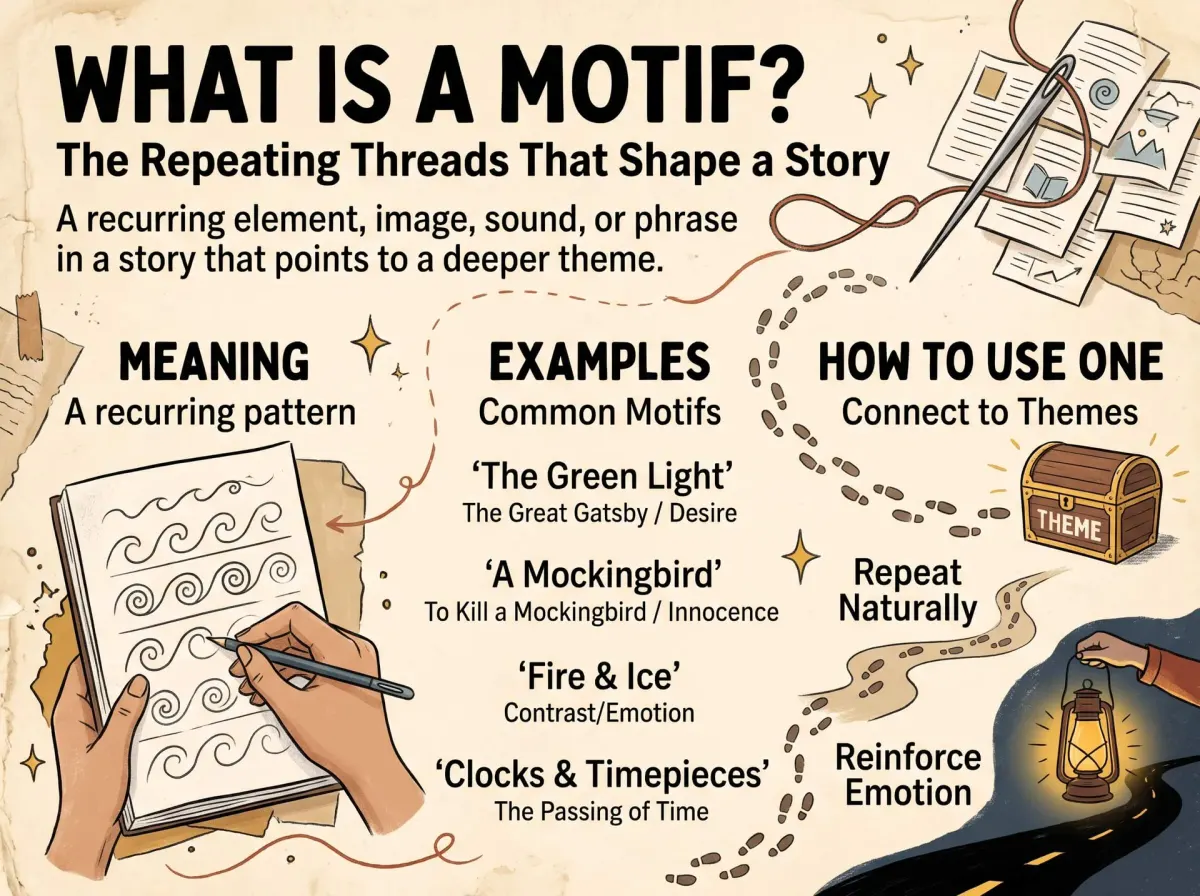
A motif is a recurring image, sound, phrase, object or idea in a story. Each repeat adds meaning and supports the central theme. A motif works across the whole book. It gains power through repetition. A single symbol can carry meaning in one appearance.
The word comes from music, where a motif is a short musical phrase that returns. Writers borrowed the idea. In a story, the repeated element plays the same role as a melody that keeps coming back.
A motif can take many forms:
- An image. Water, fire, birds or a broken mirror.
- A sound. A ticking clock or a church bell.
- A phrase. A line one character says again and again.
- An action. A gesture, a ritual or a habit.
- An idea. Betrayal, hunger or doubt that shows up in many scenes.
Merriam-Webster gives the dictionary meaning of the word.
A motif does not need to be hidden. Some are obvious. Others stay quiet until a second read. Both can work, as long as the repeats serve the story.
A motif also helps with unity. A long book has many scenes. The motif links them. A reader who sees the same image in chapter two and chapter twenty feels the shape of the whole book.
Motifs are closely tied to the main idea of the book. If you are still shaping your plot, a clear outline helps you see where a motif could return.
Motif vs theme vs symbol
Key takeaway: A theme is the big idea. A symbol stands for something. A motif repeats to build the theme.
These three terms get mixed up often. They work together, but they do different jobs.
| Term | What it is | Example |
|---|---|---|
| Theme | The central idea | Ambition corrupts |
| Symbol | An object that stands for an idea | A crown for power |
| Motif | A repeated element | Blood returns many times |
A theme is the message or question at the heart of a story. It is usually a short statement, such as "guilt cannot be washed away."
A symbol is a single thing that stands for something larger. A dove can stand for peace. A symbol can work in one scene.
A motif is the repeated pattern. When a symbol appears again and again, it becomes a motif. Blood in Macbeth is a good case. It appears in the murder, in the visions and in the sleepwalking scene. Each repeat deepens the theme of guilt.
Here is a simple way to tell them apart. Ask three questions:
- Does it repeat? If yes, it may be a motif.
- Does it stand for an idea? If yes, it may be a symbol.
- Is it the main message? If yes, it is the theme.
An element can be more than one. A recurring green light can be both a symbol and a motif. The labels are tools. Do not worry if a detail fits two boxes.
If you want to deepen how your characters carry the theme, the guide on character roles can help.
Motif examples from well-known stories
Key takeaway: In strong stories, each repeat of a motif adds a new shade to the theme.
Here are examples that many readers know.
- Macbeth. Blood returns in the murder of Duncan, in Macbeth's visions and in Lady Macbeth's attempt to wash her hands. The repeats build the theme of guilt.
- Romeo and Juliet. Images of light and dark appear again and again in the lovers' speeches. They set the theme of love against a hostile world.
- The Great Gatsby. The green light at the end of Daisy's dock appears at key moments. It stands for Gatsby's longing and returns as his hope rises and falls.
Notice what these share. The motif is concrete. It is something a reader can picture. It also changes meaning each time. Early blood means power. Late blood means shame.
Motifs also appear outside books. A film may repeat a color. A song may return to one melody. A TV series may use one phrase as a refrain.
You can find motifs in your own favorite books. Read the first chapter and the last chapter. Look for an image that appears in both. That echo is often a motif.
How often should a motif repeat?
Key takeaway: Space repeats across the book so the motif builds without feeling forced.
Most articles skip this question. They explain what a motif is but not how many repeats to use. There is no fixed rule. A spacing plan gives you a starting point.
Here is a worked example for a 60,000-word novel.
- Planned appearances of the motif: 12
- Total words: 60,000
Average gap: 60,000 ÷ 12 = 5,000 words.
Now turn words into pages. At 250 words per double-spaced page, 5,000 ÷ 250 = 20 pages. So the motif returns about every 20 pages.
That gap works for many books. A closer gap can feel heavy. A longer gap may let readers forget the thread. Test your own draft and adjust.
Next, plan the arc of meaning. Give each repeat a job:
- First repeat. Plant the image with little weight.
- Middle repeats. Link it to a character's choice or feeling.
- Late repeats. Twist the meaning, so the image feels changed.
- Final repeat. Close the circle at the climax or ending.
For a 12-repeat plan, spread them like this: 2 in the first quarter and 4 in the second. Put 4 in the third and 2 in the last. Add them up: 2 + 4 + 4 + 2 = 12. The middle carries the weight, which suits the rise of tension.
A shorter work needs fewer repeats. A 3,000-word short story may need only three. A guide for beginners shows how to scale for short fiction.
How to add a motif in revision
Key takeaway: Pick one element, mark where it could return, then revise those scenes.
You do not need to plan a motif before the first draft. Many writers find it in revision. Use these steps.
- Read your draft and note recurring images.
- Pick one element tied to your theme.
- List scenes where it could appear.
- Add or sharpen it in six to twelve scenes.
- Change its meaning at least once.
- Remove repeats that feel forced.
- Read the book again to check the rhythm.
Step one is useful because many drafts already hold a motif by accident. The writer used rain in three chapters without planning it. Spotting that thread lets you build on it.
Step five matters most. A motif that always means the same thing can feel flat. Let it grow. A locked door can start as fear and end as freedom.
Keep each repeat short. One line or one image is enough. Heavy explanation kills the effect. Trust the reader to notice.
Last, watch for overuse. If every scene has the motif, it stops being special. A good motif is felt more than spotted.
Common ways to use motifs
Key takeaway: Motifs can anchor chapters, frame a book or mark a character's change.
Writers use motifs in a few common ways.
- Chapter anchors. A small detail opens or closes several chapters.
- A frame. The same image opens and closes the book.
- Character markers. A habit or object follows one character and shows their change.
- Setting echoes. A season, a storm or a place returns at key turns.
A motif can also work in a series. One image can run across several books and link them. It may start small in book one and grow in book three.
In non-fiction, motifs work as well. A memoir might return to a kitchen table, a song or a road. The repeat gives structure to real events that have no plot of their own.
Poetry uses motifs heavily. A poem may repeat a word or image in each stanza. The repeat gives rhythm and meaning in a few lines.
People Also Ask
What is the difference between a motif and a theme?
A theme is the central idea of a story. One example is "guilt cannot be washed away". A motif is a repeated image or phrase that supports the theme. The theme answers what the story says. The motif is one of the tools that helps say it.
Can a motif be a symbol?
Yes. A symbol that repeats becomes a motif. Blood in Macbeth is a symbol of guilt. It also repeats through the play, so it works as a motif. A symbol can appear once. A motif needs several repeats to build meaning.
How many motifs should a book have?
There is no fixed number. Many books have one strong motif and a few minor ones. Too many can blur the theme. Start with one that ties to your main idea. Add a second only if it supports a different thread, such as a subplot or character.
Common mistakes
- Repeating an element without changing its meaning.
- Explaining the motif in the text, so the reader feels talked down to.
- Using so many motifs that none stands out.
- Placing repeats too close together.
- Choosing a motif that does not tie to the theme.
Your next step: map your motif
Pick one recurring element in your draft. List the scenes where it appears. Use the 12-repeat plan as a model, then check the spacing. Add or cut repeats until the rhythm feels right.
If you need to plan how your story's parts fit, a guide on writing a novel can help.