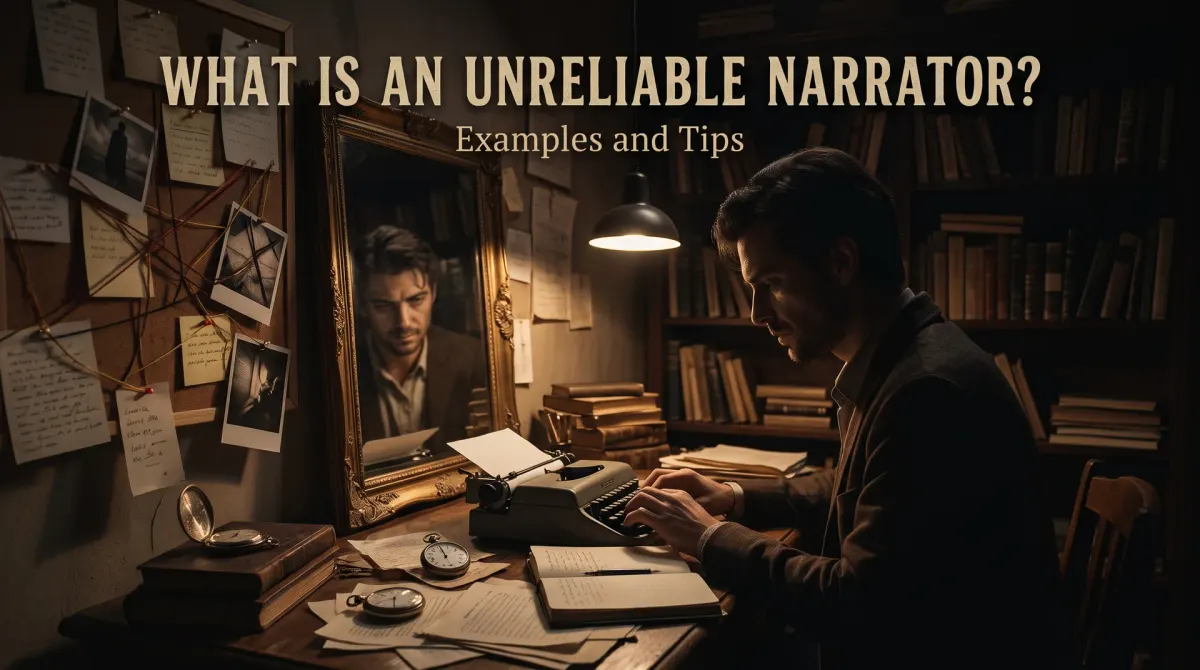
What is an unreliable narrator?
Key takeaway: An unreliable narrator is a storyteller whose account the reader cannot take at face value.
An unreliable narrator is a storyteller whose account cannot be fully trusted. The narrator may lie, forget, misunderstand events or leave out key facts. Readers must look for clues in the text to learn what really happened. The gap between telling and truth shapes the story.
Every narrator has limits. A first-person narrator sees only part of the world. What makes one unreliable is a gap between what the narrator says and what the text shows. The reader senses it, even if the narrator does not.
Unreliable does not always mean lying. A narrator can be wrong without knowing it. A child may misread an adult scene. A man in grief may see his past in a false light.
The term is closely tied to point of view. Most unreliable narrators are first person, because the reader depends on one voice. Third-person narrators can also be unreliable, though this is rarer.
Merriam-Webster lists the broader term "narrator."
The device is a strong tool in mystery and psychological fiction. It builds doubt. The reader stays alert and reads each line with care.
Choosing this device starts with your point of view. A guide on viewpoint types can help you compare options.
Types of unreliable narrator
Key takeaway: Narrators are unreliable for different reasons: lies, limits, bias or confusion.
Writers sort unreliable narrators by cause. Here are the common types.
| Type | Why the narrator misleads | Example feel |
|---|---|---|
| The liar | Chooses to deceive | Hides a crime |
| The naive | Does not understand events | A child or an outsider |
| The biased | Sees events through strong views | Pride, love or fear |
Other types also appear in craft books:
- The mentally unwell narrator. Illness or trauma shapes what the narrator sees.
- The memory-limited narrator. The narrator forgets or confuses the past.
- The self-deceiving narrator. The narrator lies to themselves first.
- The picaro. A charming rogue who exaggerates.
Some narrators fit more than one type. A grieving narrator may be biased and memory-limited at once.
Reliable and unreliable are not a strict split. They form a scale. A narrator may be mostly honest with one big blind spot. That blind spot becomes the center of the book.
Think of how much your narrator knows, how much they say and how much they hide. Those three questions set the type. Write them down before you draft.
Famous unreliable narrators
Key takeaway: Strong examples give the reader enough clues to see the truth on a second read.
Here are well-known examples. Details vary, so treat the labels as common readings.
- The Great Gatsby. Nick Carraway says he is one of the few honest people he knows. Yet he shapes the story to fit his view of Gatsby.
- The Catcher in the Rye. Holden Caulfield tells his story with strong bias and a shaky grasp of his own motives.
- Gone Girl. The story gives two accounts that do not match, and the reader must decide whom to believe.
- The Murder of Roger Ackroyd. Agatha Christie's novel is famous for a narrator who hides a key truth.
Notice what these books share. The narrator has a voice the reader enjoys. The doubt grows slowly. Clues sit in plain sight. A reader who goes back can see them.
A warning about spoilers: the last example is famous for its twist. If you plan to read it, you may wish to skip details. Many readers enjoy it best with no prior hints.
Unreliable narration also appears on screen. Films use voice-over or a framed story to cast doubt. The tools differ, but the idea is the same.
How to plant clues the reader can find
Key takeaway: Plan clues in layers so the truth feels earned, not tricked.
Most pages describe the device but skip the craft. The key is fair play. The reader must be able to find the truth from clues in the text.
Here is a worked clue plan for a 70,000-word novel with a hidden truth.
- Early clues (first 25 percent): 3
- Middle clues (next 50 percent): 5
- Late clues (last 25 percent): 2
Add them up: 3 + 5 + 2 = 10 clues.
Now find the spacing. The novel runs 70,000 words. Ten clues give an average gap of 70,000 ÷ 10 = 7,000 words. At 250 words per page, that is 7,000 ÷ 250 = 28 pages.
That plan has enough clues to reward a second read. It also avoids stacking them too early. A twist with only one clue feels sudden. A twist with 20 clues feels obvious.
Use three kinds of clue:
- Small gaps. The narrator skips a time, a name or a question.
- Contradictions. The narrator says one thing, and a detail says another.
- Other voices. A side character reacts in a way that does not fit the narrator's story.
Hide clues in plain sight. Put them inside action or dialogue, not in a lone sentence. Give each clue a surface meaning that makes sense on a first read. On a second read, the true meaning appears.
If your twist shifts the whole story, a guide to plot twists shows how to pace the reveal.
How to write an unreliable narrator step by step
Key takeaway: Decide what the truth is first, then build the lie around it.
Use these steps to plan and draft.
- Write the true version of events first.
- Decide why the narrator misleads.
- List what the narrator will hide.
- Plan ten clues across the book.
- Draft with a strong, likable voice.
- Reveal the truth near the climax.
- Reread to check fairness.
Step one is the one most writers skip. You cannot plant clues if you do not know the facts. Write a plain timeline of what really happened. Keep it separate from the draft.
Step two sets the voice. A liar sounds different from a self-deceiver. A liar may be smooth. A self-deceiver may over-explain.
Step five is a trap for beginners. A narrator who sounds shifty from page one gives the game away. Make the voice warm and persuasive. Readers will trust it, and the twist will hit harder.
Step six is about timing. Reveal too early and the book has nothing left. Reveal too late and the reader feels cheated. Many books place the reveal in the last quarter.
An outline can help you track both the true timeline and the told timeline.
Risks and how to avoid them
Key takeaway: The device fails when readers feel tricked. Fairness keeps trust.
Unreliable narration has real risks. Plan for them.
- The cheat. The reveal comes from nowhere, with no clues. Fix it by adding at least five clues.
- The shifty voice. The narrator seems false from page one. Fix it by giving the voice charm.
- The dull reread. After the twist, the book has no depth. Fix it by layering meaning into every clue.
- The confusing mix. The reader cannot tell what is real. Fix it by giving at least one fixed fact.
Keep one anchor of truth in the book. Readers need firm ground to test the rest. It can be a date, a document or a witness. Readers need one fixed point to test the rest.
Also respect sensitive topics. If the narrator has an illness, avoid cheap stereotypes. Show a person, not a trick. Research the condition and show the effect with care.
Unreliable narrators in different forms
Key takeaway: The device works in novels, short stories, film and memoir, but each form needs its own care.
In a novel, you have room to build trust and then break it. The long run lets clues pile up. A short story has less room. It often relies on one strong clue and a fast reveal.
In film, a voice-over or a framed story can cast doubt. The camera can show what the narrator hides. Viewers then see the gap at once.
In memoir, the question is different. A memoir narrator is a real person who remembers the past. Memory is never perfect. Good memoirists admit this. They may say, "I think it happened this way." That honesty builds trust rather than breaking it.
In children's stories, a naive narrator can charm readers. A child may misread a grown-up quarrel. The reader sees more than the child does. This gap is gentle, and it works well for humor.
Series fiction can stretch the device over several books. A narrator may seem honest in book one and reveal a lie in book three. This takes careful planning. Keep notes on what each book reveals.
People Also Ask
What is an example of an unreliable narrator?
Holden Caulfield in The Catcher in the Rye is a common example. He tells the story with strong bias and limited self-knowledge. Nick Carraway in The Great Gatsby and the narrator of The Murder of Roger Ackroyd are also often cited. Each gives the reader reasons to doubt.
Why do authors use unreliable narrators?
Authors use them to build doubt and keep readers alert. The device can create a twist that changes how the whole story reads. It also shows how people see themselves. The gap between what is told and what is true can reveal character in a deep way.
Is an unreliable narrator always lying?
No. A narrator can be wrong without lying. A child may not understand what they see. A grieving person may remember events in a false light. Some narrators lie to themselves. The key is a gap between the account and the truth, not intent.
Common mistakes
- Giving no clues, so the twist feels like a cheat.
- Making the narrator sound false from the first page.
- Revealing the truth too early.
- Using illness as a cheap trick.
- Breaking your own rules about what the narrator knows.
Your next step: write the true timeline
Open a blank page and write what really happened, in order. Then list ten clues and place them along the draft using the 70,000-word plan. Check that each clue has a surface meaning and a hidden one.
When the plan is clear, test the first page with a friend. If they trust the narrator, the setup works.