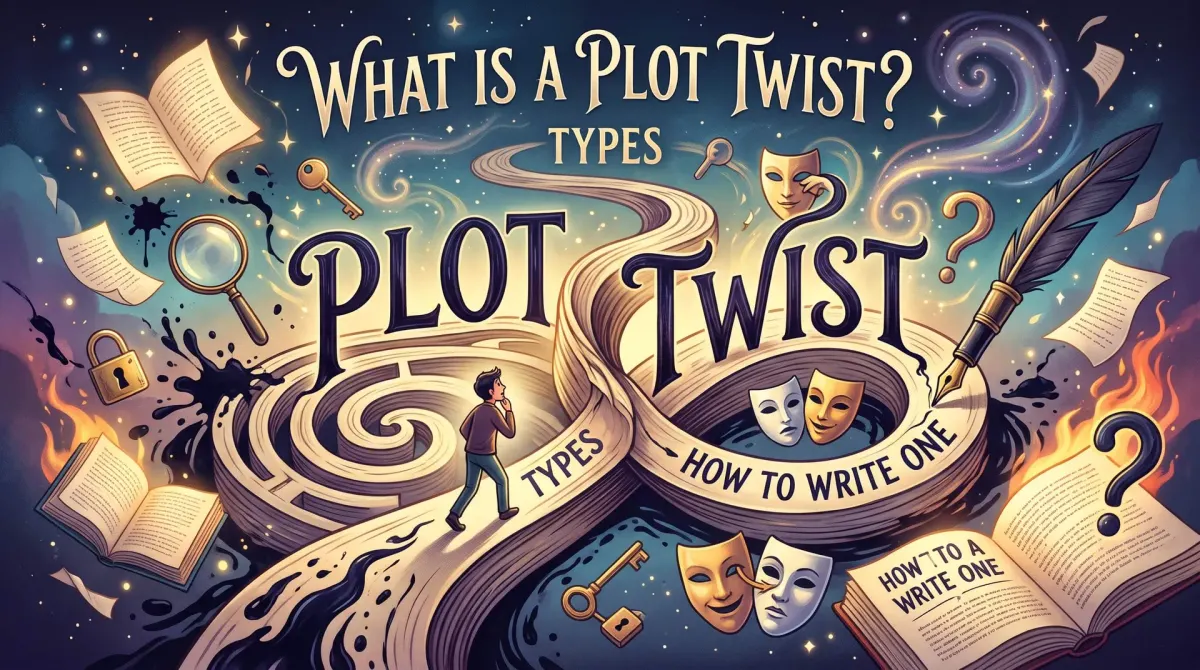
What is a plot twist?
Key takeaway: A plot twist changes the reader's view of the story, and it must feel fair after the reveal.
A plot twist is an unexpected change in a story's direction. It can also change what the reader believes is true. It surprises the audience but makes sense in hindsight. A good plot twist rests on earlier clues. The reader can look back and see how the story set it up.
A twist is more than a surprise. A random event is a surprise. A twist changes the meaning of what came before. The reader sees old scenes in a new light.
Merriam-Webster lists the phrase under twist.
A twist should meet three tests:
- It surprises. The reader did not guess it.
- It is fair. Earlier clues point to it.
- It matters. It changes the story, not just a detail.
If a twist fails the first test, it is predictable. If it fails the second, it is a cheat. If it fails the third, it is trivia.
Twists live in the plot, but they affect theme as well. A twist about a friend's betrayal can deepen a theme of trust.
Planning a twist starts with the whole plot. An outline helps you see where a change could land.
Types of plot twist
Key takeaway: Twists come in several forms. Pick the one that fits your story's theme.
Writers name a handful of common types.
| Type | What changes | Example feel |
|---|---|---|
| Reveal | A hidden truth comes out | The ally is the villain |
| Reversal | The situation flips | The hunter becomes prey |
| Betrayal | Someone breaks trust | A friend turns |
More types worth knowing:
- The false victory. The lead seems to win, then loses.
- The false defeat. The lead seems beaten, then wins.
- The identity twist. A character is not who they seem.
- The unreliable narrator twist. The narrator has lied or misled.
- The time twist. The reader learns events are out of order.
- The hidden connection. Two threads turn out to be linked.
- The twist ending. A final scene flips the meaning of the story.
Different genres favor different twists. Mystery likes the reveal. Thriller likes the reversal. Fantasy likes the hidden bloodline. Romance may use a betrayal or a second chance.
A twist can be big or small. A big twist changes the whole book. A small twist changes a scene. A story with many small twists keeps pace. A story with one big twist builds toward it.
Some twists lean on the narrator. If you plan a voice that hides the truth, plan the clues with care. The novel guide shows how to map them across a full draft.
Plot twist examples
Key takeaway: Strong twists change the meaning of earlier scenes and stay true to character.
Here are well-known examples. Spoilers follow, so skip any you plan to read.
- Romeo and Juliet. A message that Juliet is only sleeping never reaches Romeo. He kills himself. The twist of timing drives the tragedy.
- The Murder of Roger Ackroyd. The narrator is revealed to be the killer. The book is famous for its fair clues.
- Great Expectations. Pip learns that his secret benefactor is not who he thought. The reveal reshapes his view of his life.
- Harry Potter and the Prisoner of Azkaban. Characters Harry believes to be enemies and allies prove to be the opposite.
Film and TV use twists often. Some films are known for a final reveal that makes viewers want to watch again.
Notice what these twists share. Each follows from character choices. Each recasts earlier scenes. And each was planted well before the reveal.
Think of a twist as a hinge. The story swings on it. The scenes before and after should both feel true.
Where to place a plot twist
Key takeaway: Place the main twist late enough to build tension and early enough to leave time for the fallout.
Most pages say "put the twist near the end" and stop. A placement calculation gives you a start.
Here is a worked example for a novel of 80,000 words with 40 chapters.
- Planned twist position: 75 percent of the way through
- Calculation: 80,000 × 0.75 = 60,000 words
- Chapter position: 40 × 0.75 = chapter 30
So the twist lands at about word 60,000, in chapter 30.
Now check what is left after the twist.
- Words left: 80,000 − 60,000 = 20,000 words
- Chapters left: 40 − 30 = 10 chapters
- Share left: 20,000 ÷ 80,000 = 0.25, or 25 percent
That gives the story one quarter of its length to deal with the result. A twist with only two or three chapters left may feel rushed. A twist with half the book left may feel early.
This is a planning idea, not a rule. Some books place a twist at the midpoint. Others place it in the last scene. The right place depends on the story.
Many novels also use more than one twist. A common pattern is a small twist near the middle and a major one near three quarters. The first sets expectations. The second breaks them.
Check your pacing with a chapter-length guide. It helps you plan where the 75 percent mark falls.
How to write a plot twist step by step
Key takeaway: Start with the truth, plant clues, then reveal at the right time.
Use these steps to build a twist.
- Decide the truth the reader will learn.
- Write what the reader will believe first.
- Plant three to five clues.
- Hide each clue inside action or dialogue.
- Place the reveal at the planned point.
- Show how the twist changes earlier scenes.
- Reread the book to check fairness.
Step two is key. A twist needs a false belief to break. Make that belief strong. Give the reader reasons to believe it.
Step four is the craft. A clue in plain sight, inside a busy scene, is easy to miss. A clue placed alone in a quiet line stands out. Hide clues among other details.
Step six pays off the effort. After the reveal, let the reader see old scenes anew. A short flash of memory can do this. A character may realize what a past line meant.
Also consider the red herring. This is a false clue that leads the reader toward a wrong answer. Use a few. They add noise and make the true clues harder to spot. But each needs a reason to exist.
Test your twist with readers
Key takeaway: Ask readers what they guessed, and use the results to tune the clues.
Few articles tell you how to test a twist. A simple reader test gives you data.
Ask ten beta readers to stop before the reveal and write what they think will happen. Then count how many guess the twist.
Here is a worked example.
- Readers who guessed the twist: 3
- Readers total: 10
- Share who guessed: 3 ÷ 10 = 0.30, or 30 percent
What does 30 percent mean? About three in ten saw it coming. That is a useful balance for many mysteries. The twist surprises most readers, but some feel clever, which many enjoy.
Now read the other result. Ask all ten after the reveal: "Did the twist feel fair?"
- Readers who said yes: 8
- Share: 8 ÷ 10 = 0.80, or 80 percent
An 80 percent fair rating is strong. If the rating falls below half, add clues. If most readers guess early, hide the clues better or add red herrings.
These targets are planning ideas, not standards. Different genres and audiences vary. The goal is to see where your twist stands.
Use the results in revision. If few guess and few call it fair, you need more clues. If many guess and many call it fair, you may have too many clues.
People Also Ask
What makes a good plot twist?
A good twist surprises the reader, rests on earlier clues and changes the meaning of the story. It also follows from character choices. After the reveal, readers should be able to look back and see how the story set it up. A twist that comes from nowhere feels like a cheat.
Where should a plot twist go in a story?
Many novels place the main twist about three quarters of the way through. That leaves time to show its effects. Some twists land at the midpoint, and some in the final scene. In an 80,000-word book, the 75 percent mark is at word 60,000. Adjust to fit your story.
What is the difference between a plot twist and a red herring?
A plot twist is a real change in the story. A red herring is a false clue that points the reader the wrong way. Red herrings support twists by adding noise. A fair story uses them with care, so each has a reason to be in the book.
Common mistakes
- Planting no clues, so the twist feels like a cheat.
- Planting so many clues that the twist is obvious.
- Using a twist that breaks the story's own rules.
- Revealing the twist too late to deal with the result.
- Using a twist only to shock, with no link to theme.
Your next step: map your twist
Write the truth and the false belief. List three to five clues and place them in your outline. Calculate where the reveal falls, using the 75 percent example as a model. Then test with a few readers.
If you are still building the story's end, a short story is a good place to practice.