What is an anthology?
Key takeaway: An anthology is a curated collection of works, gathered around a shared idea.
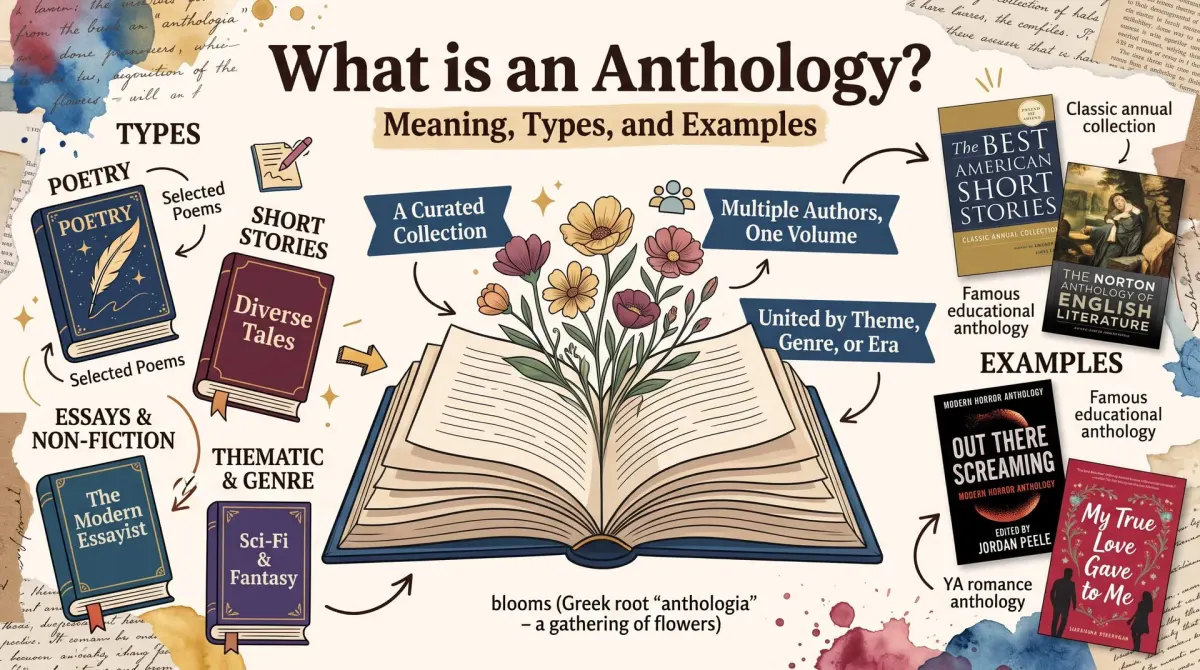
An anthology is a published collection of works, such as stories, poems or essays. An editor chooses them and gathers them in one book. The works may come from many writers or from one. A theme, form, period or cause usually ties the pieces together.
The word comes from a Greek term for a gathering of flowers. The image fits. An editor picks the best blooms and arranges them in one bouquet.
Merriam-Webster gives the dictionary meaning.
An anthology has three key features:
- Many pieces. Each piece is complete on its own.
- An editor. One person or team selects and orders the works.
- A link. A theme, form, period or cause holds the book together.
An anthology differs from a single-author book. In a novel, one author shapes one story. In an anthology, the editor shapes the book, and the contributors shape the pieces.
An anthology also differs from a collection. People often use the words as if they were the same. Many say a collection holds works by one author, while an anthology holds works by several. The line is not fixed.
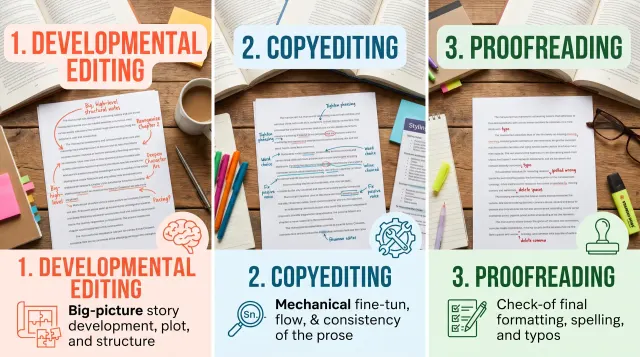
If your pieces are short stories, a short story guide can help your contributors and you.
Types of anthology
Key takeaway: Anthologies differ by form, theme and purpose. Choose the type before you recruit writers.
| Type | What it holds | Example use |
|---|---|---|
| Short story | Stories by many writers | A genre or theme book |
| Poetry | Poems from many voices | A regional or school book |
| Essay | Personal or argued essays | A topic or cause book |
More types are common:
- Themed anthology. All pieces share one subject, such as winter, travel or loss.
- Genre anthology. The pieces share a genre, such as horror or science fiction.
- Charity anthology. Proceeds go to a cause. Contributors often give their work free.
- Annual "best of" anthology. An editor picks the year's best writing.
- Textbook anthology. A teaching book of works from a period or region.
- Mixed-form anthology. It combines stories, poems, essays and art.
- Single-author anthology. An author's selected works, often called a "selected" or "best of".
The purpose shapes the choices. A charity book needs a cause that people care about. A textbook needs balance and range. A genre book needs a tight fit with reader taste.
Anthology examples
Key takeaway: Known anthologies show how a clear frame helps a collection.
Several anthologies are widely known.
- The Norton Anthology of English Literature. A large teaching anthology of English writing across many periods.
- The Oxford Book of English Verse. A long-running poetry anthology.
- The Best American Short Stories. An annual series, where a guest editor picks the year's stories.
- Chicken Soup for the Soul. A large series of true, uplifting stories on set themes.
Notice how each has a frame. One covers a literature. One covers a form. One covers a year. One covers a mood. A frame tells the reader what to expect.
Notice also the role of the editor. In an annual series, the editor's taste shapes the book. In a teaching anthology, the editor decides which voices are heard.
Smaller anthologies work the same way. A local writers' group may publish a book of poems about their town. The frame is the town. The editor is a member of the group.
How much does an anthology cost? A contributor budget
Key takeaway: Decide how you will pay contributors before you recruit them.
Most pages skip the money. Yet payment is the first question writers ask.
Say you plan an anthology of 15 stories. Each story runs about 4,000 words.
- Total words: 15 × 4,000 = 60,000 words
You have a few payment models.
Model 1: pay per word. Say you pay 2 cents per word.
- Cost per story: 4,000 × $0.02 = $80
- Total: 15 × $80 = $1,200
Model 2: flat fee. Say you pay $80 per story. The total is the same: 15 × $80 = $1,200.
Model 3: royalty share. No upfront pay. Contributors share a part of the book's royalties. Say half of the royalties are shared among 15 writers.
- Each writer's share: 50% ÷ 15 = about 3.33%
If the book earns $900 in royalties, the shared pool is 50% of $900, which is $450. Each writer gets $450 ÷ 15 = $30.
Compare the models. A flat fee gives writers $80 each, up front. The royalty model gives them $30 in this example, but only if the book sells. The better model depends on your budget and your goals.
Other costs include:
- Cover design
- Editing and proofreading
- Formatting
- ISBN and listing
- Marketing
Add a line for each cost, then compare the total with your expected income. A guide covers what publishing a book costs.
These figures are examples, not rates. Pay rates vary widely.
How to put together an anthology step by step
Key takeaway: Fix the theme, call for work, sign contracts, then edit, format and publish.
Use these steps to build one.
- Choose a clear theme and form.
- Set word limits and a deadline.
- Post a call for submissions.
- Pick pieces and send contracts.
- Edit each piece and order the book.
- Format, proof and add a copyright page.
- Publish and share the book with contributors.
Step three is the call for submissions. State the theme, word limit, deadline, pay and rights you seek. Say how to submit. Clear rules reduce bad fits.
Step five is the editor's art. Order matters. Open with a strong piece. Place similar tones apart. End with a piece that leaves a mark. Read the book as a reader would, from start to finish.
Step six needs care. Use one style for headings, fonts and bios. Give each contributor a short author bio. A guide shows how to write one.
Finally, plan a launch. Contributors can share the book with their own readers. That gives the book far more reach than one editor alone.
How to order the pieces in an anthology
Key takeaway: Order shapes the reading experience. Plan the opening, the middle and the close.
Order is the editor's craft. A random order tires the reader.
Use a simple plan for 15 stories.
| Slot | Stories | Goal |
|---|---|---|
| Opening | 1 to 3 | Hook the reader |
| Middle | 4 to 12 | Vary tone and length |
| Close | 13 to 15 | Leave a strong mark |
Check the slots: 3 + 9 + 3 = 15 stories.
Then apply these rules.
- Put a strong story first or second.
- Avoid placing several sad or heavy stories in a row.
- Alternate long and short pieces.
- Save a memorable piece for last.
- Read the whole book in one sitting before you lock the order.
- Test the order with one trusted reader. Ask where they felt bored or lost.
Here is a quick example. Say stories 4, 5 and 6 each run 6,000 words. The middle will drag. Swap in a 1,500-word piece to reset the pace.
Also write a short editor's note. A note of 500 to 1,000 words can explain the theme and the call for work. It can also thank contributors. It helps readers see the frame.
Last, add a table of contents with page numbers and a short bio for each contributor.
Rights, contracts and publishing
Key takeaway: Put the deal in writing. Contributors usually keep their rights, and you license what you need.
An anthology involves many owners. Each contributor owns the copyright in their own piece, unless a contract says otherwise. The editor often owns the copyright in the selection and arrangement.
A contributor agreement should cover:
- Rights granted. For example, the right to print the piece in this book.
- Time frame. How long the right lasts.
- Payment. Amount, date and method.
- Credit. How the name appears.
- Reprints. Whether the writer may publish the piece elsewhere.
- Warranty. The writer states the piece is original.
Keep a signed copy from every contributor. Do this before publication.
You also need an ISBN for the book if you sell it widely. A guide explains the options.
Seek legal advice for large projects. This guide is not legal advice.
People Also Ask
What is the difference between an anthology and a collection?
Many people say a collection holds works by one author, while an anthology holds works by several. The line is not fixed, and some writers use the terms alike. In both, the pieces are complete works gathered into one book and arranged by an editor or the author.
What are some examples of anthologies?
Well-known examples include The Norton Anthology of English Literature and The Oxford Book of English Verse. Others are The Best American Short Stories and Chicken Soup for the Soul. Each has a frame: a literature, a form, a year or a mood. Local groups also publish small themed anthologies.
Who owns the rights to a story in an anthology?
Usually the contributor owns the copyright in their own piece, unless a contract says otherwise. The editor may own rights in the selection and arrangement. A contributor agreement should list the rights granted, the time frame, payment, credit and reprint terms. Get it signed before publication.
Common mistakes
- Recruiting writers before choosing a clear theme.
- Skipping written contracts.
- Failing to plan the payment model.
- Ordering pieces at random.
- Ignoring costs for editing, cover design and formatting.
Your next step: draft your budget
Pick a story count and a word limit. Multiply to find the total words. Choose a payment model and work out the cost. Add the other costs and compare the total with your goal.
Once the plan is set, a self-publishing checklist helps you finish.